
Table of contents
- Introduction
- What are XL porcelain slabs?
- XL porcelain slabs vs. slab marble: what’s the difference?
- Why homeowners are choosing floor-to-ceiling porcelain tile
- How XL porcelain slab installation works
- Why large-format porcelain slabs require specialized installation
- Porcelain slab shower walls: what homeowners should know
- How much does a porcelain slab shower cost?
- When porcelain slabs make more sense than traditional tile
- How to choose a qualified porcelain slab installer in New Jersey
- Frequently asked questions
- Conclusion
Introduction
For homeowners planning a luxury bathroom, statement shower, kitchen renovation, or sophisticated feature wall, material selection is only part of the decision. The installation method can be just as important. XL porcelain slab installation is fundamentally different from installing conventional ceramic or porcelain tile. Instead of working with dozens of smaller pieces, installers handle exceptionally large panels that can reach approximately 3 meters in height and width. These slabs can create a highly continuous appearance with significantly fewer grout joints, but their size, weight, transportation, fabrication, and positioning require specialized planning. For New Jersey homeowners comparing large-format porcelain slabs with natural marble, the right choice depends on aesthetics, maintenance expectations, budget, application, and the capabilities of the installation team. Gus Skyy Co. specializes in flooring, tile, remodeling, and XL porcelain slab installation for residential projects. If you are considering a large-format bathroom or shower design, you can discuss your project directly at (973) 493-6710.
What are XL porcelain slabs?
XL porcelain slabs are very large-format porcelain panels manufactured to cover substantial wall, floor, countertop, or other architectural surfaces with fewer individual pieces. Unlike conventional tile, which is typically installed piece by piece, a large porcelain panel may span most or all of a shower wall. Depending on the product and design, a single panel can extend from floor to ceiling, creating a clean visual plane with fewer interruptions. Large-format porcelain is available in many colors, textures, finishes, and marble-inspired patterns. Some products are designed to replicate the appearance of natural stone while offering the manufacturing consistency associated with porcelain. The scale is what changes the installation process. A large slab cannot simply be carried, positioned, cut, and bonded in the same manner as a standard tile. Handling may require specialized lifting equipment, suction-cup systems, or suction rigs when appropriate. Transportation and site access also need to be considered before the slab arrives. This is why large format porcelain slabs NJ projects should be approached as specialty installations rather than simply oversized tile jobs.
XL porcelain slabs vs. slab marble: what’s the difference?
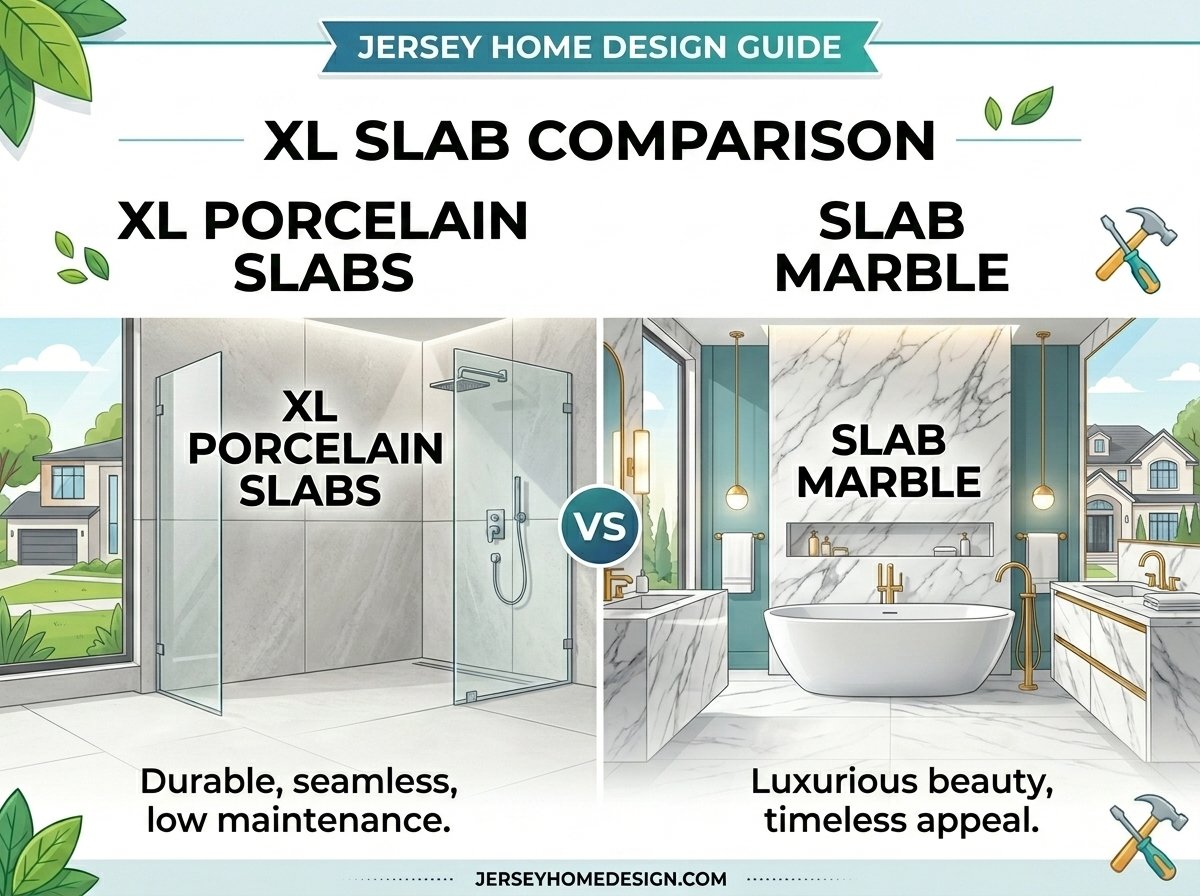
Porcelain and natural marble can both create an exceptionally high-end appearance, but they behave differently and offer different advantages. Appearance: Natural marble has unique veining and variations because each piece is a natural stone. Porcelain can reproduce marble-inspired patterns with a more controlled appearance and can provide greater consistency when matching multiple surfaces. Porosity: Marble is a natural stone and is generally more porous than porcelain. That means maintenance and sealing considerations can be more important with marble, particularly in areas exposed to moisture and staining substances. Maintenance: Porcelain is generally valued for relatively straightforward maintenance. Marble can require more care to preserve its appearance, including attention to appropriate cleaning products and sealing requirements depending on the stone and application. Durability: Both materials can perform well when properly selected and installed. Porcelain is highly durable, but it is not indestructible. Large panels can be damaged by improper transportation, handling, cutting, substrate conditions, or installation. Weight and installation: Both large porcelain slabs and natural stone slabs can require careful handling. The installation process depends on the material, dimensions, thickness, substrate, and application. Design flexibility: Porcelain offers an extensive range of colors, stone-look patterns, finishes, and formats. Marble provides the authentic variations and character of natural stone. Neither material is automatically better. The right choice depends on the project’s design goals, maintenance expectations, application, budget, and installation requirements.
Why homeowners are choosing floor-to-ceiling porcelain tile
Floor to ceiling porcelain tile has become particularly appealing in luxury bathrooms because it can make the architecture feel more continuous and intentional. In a shower, large panels can dramatically reduce the number of visible grout joints compared with a traditional small-format tile layout. This creates a cleaner visual field and can complement minimalist and contemporary interiors. Large panels are also effective for marble-look designs. Instead of breaking a dramatic pattern into dozens of individual tiles, a large-format panel can allow the visual movement of the pattern to remain more continuous across a wall. For smaller bathrooms, fewer visual interruptions can also contribute to a more spacious appearance. There are practical considerations as well. Fewer grout joints can reduce the amount of grout surface that homeowners need to clean, although porcelain slab installations are not maintenance-free. Corners, transitions, penetrations, seams, drains, and other construction details still require appropriate installation and care. For homeowners investing in a luxury bathroom, the result can be a refined combination of visual simplicity and material performance.
How XL porcelain slab installation works
XL porcelain slab installation begins well before the panel is placed on the wall. The project needs accurate measurements, layout planning, material selection, site evaluation, and consideration of how the slabs will enter the property. Large panels can present transportation and access challenges that do not exist with conventional tile boxes. The installation process can involve:
- Confirming dimensions and layout
- Planning slab transportation and site access
- Preparing and evaluating the substrate
- Planning cuts, seams, corners, and penetrations
- Accounting for plumbing fixtures and shower niches
- Preparing appropriate handling equipment
- Cutting and fabricating the porcelain panels
- Protecting slab edges during handling
- Applying the appropriate bonding material
- Positioning and securing the slab carefully
- Completing joints and transitions according to the design and application
- Inspecting and cleaning the finished surface
The exact installation requirements vary according to the porcelain manufacturer’s specifications and the application. Wet areas introduce additional considerations for waterproofing, movement, bonding, and detailing. A professional installation is therefore a coordinated process rather than a simple matter of placing a large piece of tile onto a wall.
Why large-format porcelain slabs require specialized installation
A conventional tile installer may be accustomed to working with porcelain, but that does not automatically mean the installer has experience handling very large panels. The difference starts with scale and weight. A large panel can be difficult to transport, position, and maneuver safely. Improper handling can damage an expensive slab before it is even installed. Substrate preparation is equally important. Large-format materials require appropriate attention to surface flatness because irregularities can affect bonding and positioning. Deflection and structural movement also need to be considered according to the application. Adhesive selection and coverage matter because the panel needs appropriate support and bonding across its surface. Manufacturer requirements and applicable industry practices should guide the installation process. Precise fabrication is another important factor. Large panels may require openings for plumbing fixtures, electrical components, niches, drains, corners, and other architectural details. These cuts must be planned carefully because replacing a damaged slab can involve additional material, fabrication, transportation, and labor. Gus Skyy Co. has developed a specialized team for flooring, tile, and remodeling work and has completed specialized training for XL porcelain slab applications. The company is also associated with the National Tile Contractors Association. For homeowners, the key question is not simply whether a contractor installs tile. It is whether the contractor has the appropriate experience and process for the scale and complexity of the specific porcelain slab project.
Porcelain slab shower walls: what homeowners should know
Porcelain slab shower walls are one of the most visually compelling applications for large-format porcelain. A large panel can create a cleaner wall surface with fewer grout joints and can support a luxury spa-inspired design. Marble-look porcelain is particularly popular for this type of application because it can create the appearance of a continuous stone surface. However, a shower is a demanding environment. The quality of the finished surface depends on more than the porcelain itself. Waterproofing, substrate preparation, movement considerations, bonding, corners, seams, plumbing penetrations, niches, and transitions all need to be addressed correctly. The porcelain panel is part of the overall shower system, not a substitute for proper waterproofing or preparation. Homeowners should also understand that “seamless” is primarily a design concept. Large panels can significantly reduce visible joints, but some installations will still require seams or joints depending on the dimensions, layout, manufacturer requirements, and characteristics of the space. If you are considering a luxury shower renovation, Gus Skyy Co. can discuss porcelain slab options as part of a broader bathroom remodeling project. Call (973) 493-6710 to discuss your application.
How much does a porcelain slab shower cost?
One of the most common questions homeowners ask is about porcelain slab shower walls cost. There is no responsible single price that applies to every project. The final investment can vary based on:
- Porcelain slab material, thickness, finish, and pattern
- Number and dimensions of slabs
- Fabrication requirements
- Transportation and delivery
- Site access and handling conditions
- Removal of existing tile or other materials
- Substrate preparation
- Waterproofing requirements
- Shower niches and plumbing penetrations
- Number and complexity of cuts
- Edge finishing
- Seams, corners, and transitions
- Overall installation complexity
- Labor and project size
This is why comparing contractors using only a price-per-square-foot figure can be misleading. Two quotes may cover substantially different scopes of work. A lower quote may involve differences in material selection, preparation, fabrication, waterproofing, handling, installation methods, or finishing. For a high-end bathroom, the more useful comparison is between complete scopes of work. Ask what material is included, how the substrate will be prepared, how the slabs will be transported and handled, what fabrication is included, and how complex details will be addressed. For a project-specific estimate, homeowners can contact Gus Skyy Co. at (973) 493-6710.
When porcelain slabs make more sense than traditional tile
Large-format porcelain is not necessarily the right choice for every renovation. Traditional tile can provide tremendous design flexibility and may be more appropriate for projects where smaller dimensions, intricate patterns, or detailed layouts are desired. Porcelain slabs become especially compelling when the design calls for:
- A minimalist, high-end aesthetic
- Floor-to-ceiling wall coverage
- Fewer visible grout joints
- Large marble-look surfaces
- A visually continuous shower surround
- Statement walls in bathrooms or kitchens
- A premium contemporary renovation
They can also be a strong choice when homeowners want the appearance of natural stone but prefer the characteristics and maintenance profile associated with porcelain. The tradeoff is that large panels require more planning and specialized handling. The material can be an excellent investment when the design benefits from its scale and the project is executed by an experienced installer.
How to choose a qualified porcelain slab installer in New Jersey
When comparing installers, look beyond photographs of finished bathrooms. Ask about the process behind those projects. A qualified contractor should be able to discuss how they approach large panel transportation, handling, substrate preparation, fabrication, bonding, layout, seams, corners, and penetrations. It is also reasonable to ask:
- How much experience do you have with XL porcelain slabs?
- How are large panels transported and positioned?
- What equipment is used for handling when appropriate?
- How is substrate flatness evaluated?
- How are shower waterproofing details addressed?
- How are niches, plumbing penetrations, and corners planned?
- How is slab fabrication handled?
- What manufacturer requirements apply to the selected product?
- What is included in the project estimate?
- Can you show examples of comparable installations?
Be cautious about treating an “NTCA certified porcelain slab installer” as a generic label. Credentials and training should be described accurately rather than assumed from association membership. Homeowners should ask the contractor to explain the specific training or credentials relevant to the installation. Gus Skyy Co. brings experience from residential remodeling and investor-focused renovation work, along with a specialized team for flooring and tile projects. Its work includes Livingston and surrounding New Jersey communities within its service area, including projects in parts of Essex, Morris, Union, Bergen, and Hudson counties. The company serves homeowners seeking both specialized large-format installations and broader bathroom, kitchen, and flooring renovations.
Frequently asked questions
How much does XL porcelain slab installation cost?
XL porcelain slab installation does not have one universal price. Cost depends on the slab, dimensions, thickness, fabrication, transportation, site access, substrate preparation, waterproofing, cuts, penetrations, installation complexity, and labor. A detailed project estimate is more useful than relying on a generic price-per-square-foot figure.
Are porcelain slabs better than marble for shower walls?
Neither material is automatically better. Porcelain can offer lower porosity, straightforward maintenance, and a wide range of marble-inspired designs. Natural marble provides authentic stone variation and character but may require more maintenance. The best choice depends on aesthetics, maintenance expectations, budget, and the specific shower design.
Can porcelain slabs be used from floor to ceiling?
Yes. Large porcelain panels can be installed as floor-to-ceiling wall surfaces when the selected product and application are appropriate. Their large dimensions can create a more continuous appearance with fewer grout joints. Proper substrate preparation, handling, layout, and installation are important for a successful result.
Do porcelain slabs require grout?
Large porcelain slabs can significantly reduce the number of visible grout joints, but they are not necessarily completely grout-free. Seams, corners, transitions, movement joints, and other details depend on the design, application, manufacturer requirements, and installation system.
Can porcelain slabs crack during installation?
Porcelain slabs can be damaged or cracked if they are improperly handled, transported, fabricated, supported, or installed. Proper handling, substrate preparation, bonding, movement considerations, and professional installation can reduce the risk. Large slabs should be treated as specialty materials rather than ordinary tile.
How long does porcelain slab installation take?
Installation time varies according to project size, preparation requirements, slab quantity, fabrication, site access, layout complexity, and other conditions. A shower requiring demolition, waterproofing, niche construction, multiple cuts, and detailed fabrication will involve a different schedule from a straightforward wall application.
Are large-format porcelain slabs difficult to install?
They are more technically demanding than conventional tile because of their size, weight, handling requirements, fabrication, positioning, substrate requirements, and limited tolerance for installation mistakes. This does not mean every project is exceptionally complicated, but it does mean the installer should have appropriate experience with large-format panels.
Conclusion
XL porcelain slabs offer New Jersey homeowners a distinctive way to create sophisticated bathrooms, shower walls, kitchens, and architectural feature surfaces. Compared with traditional tile, large panels can produce a more continuous appearance with significantly fewer grout joints. Compared with natural marble, porcelain offers a different combination of maintenance, consistency, design flexibility, and performance characteristics. The most important consideration, however, is not simply selecting an attractive slab. XL porcelain slab installation requires careful planning, specialized handling, accurate fabrication, appropriate substrate preparation, and professional execution. For homeowners in Livingston and surrounding New Jersey communities who are considering a luxury bathroom, shower renovation, kitchen project, or other large-format porcelain application, Gus Skyy Co. offers specialized flooring, tile, and remodeling services with particular experience in XL porcelain slab work. Whether you already have a specific slab selected or are still comparing porcelain and marble, a professional consultation can help you understand the material, installation process, scope, and project considerations before work begins. Ready to explore XL porcelain slabs for your New Jersey home? Contact Gus Skyy Co. to discuss your project, ask about large-format porcelain installation, or request a project estimate at (973) 493-6710.