
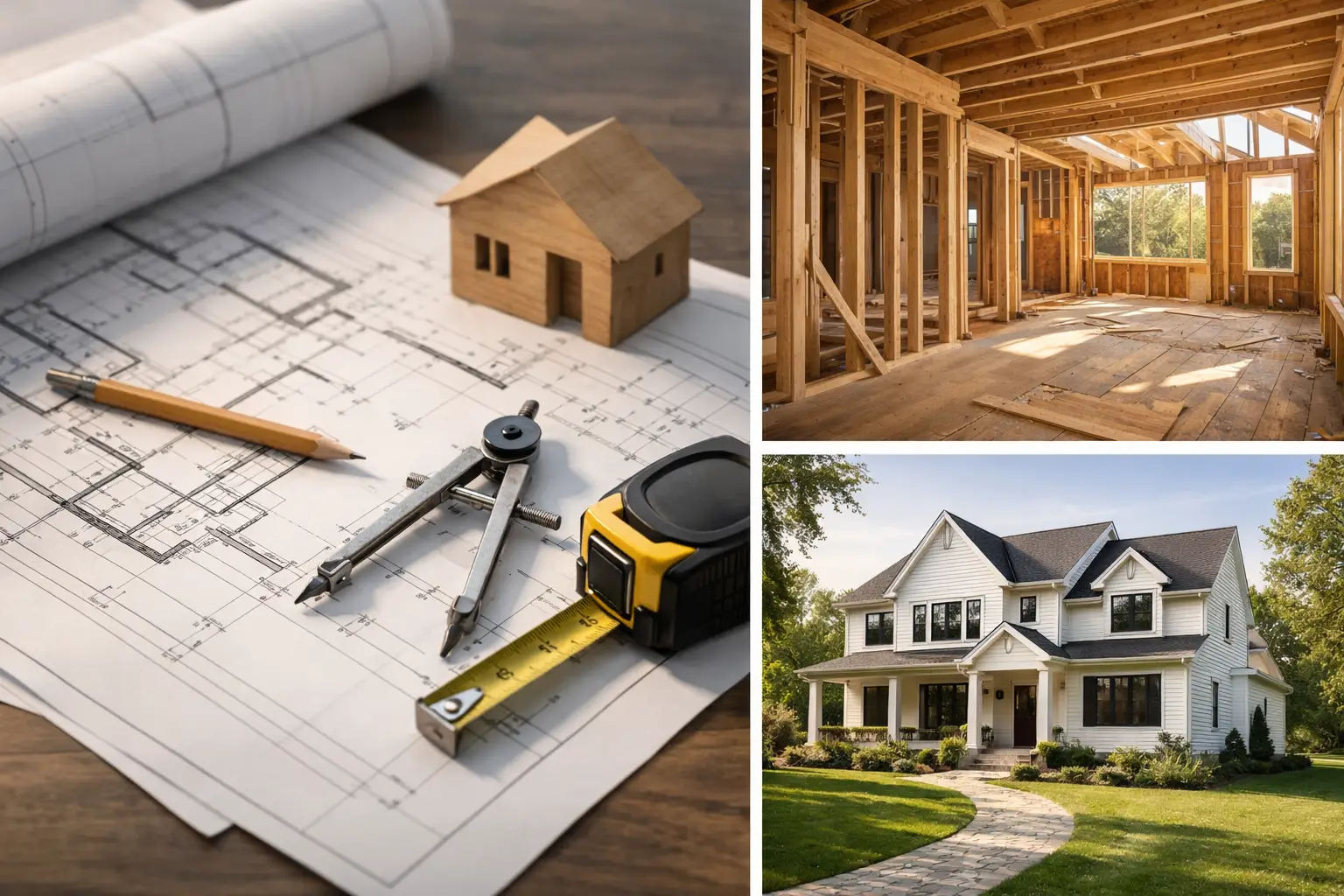
The expensive mistakes in a custom home usually happen before excavation starts. A house can look clean on paper and still run into grading problems, septic limits, delayed permits, utility conflicts, or a layout that does not match how the family actually lives. That is why knowing how to plan a custom home build matters more than picking finishes early.
In New Jersey, planning is not a soft preconstruction phase. It is where you test the site, the budget, the township process, and the design against each other. If one of those four moves out of alignment, the project gets slower and more expensive. Good planning is not about making the process feel fancy. It is about removing avoidable surprises.
How to plan a custom home build starts with the lot
If you already own the property, the first question is not style. It is constraints. If you are still shopping lots in towns like Short Hills, Chatham, Saddle River, or Franklin Lakes, this step is even more important because two similarly priced properties can have very different build conditions.
Start with the basics – survey, zoning, setbacks, easements, topography, utility access, drainage patterns, and soil conditions. A flat, clear lot with straightforward utility connections is a very different project from a sloped site with retaining needs, mature tree restrictions, or stormwater requirements. In parts of Essex and Union counties, older neighborhoods can also bring unknowns like buried structures, lead-related site concerns, and utility upgrades that were not obvious during purchase.
The lot should shape the house, not the other way around. A design that ignores slope, solar orientation, drainage flow, or driveway grades tends to get redesigned later. That redesign costs time. In some townships, it also restarts reviews.
Set the brief before the drawings get too far
A custom home is not just a larger version of a renovation. The planning brief has to be specific enough to guide design decisions before they become structural or mechanical commitments.
That means getting clear on square footage range, bedroom and bath count, home office needs, first-floor guest suite requirements, ceiling heights, garage configuration, mudroom function, kitchen workflow, storage expectations, and whether the basement is unfinished, partially finished, or designed for full living use. In New Jersey, basement planning deserves extra attention because moisture, sump strategy, slab details, and exterior drainage are not afterthoughts.
This is also where priorities need to be ranked honestly. Most homeowners want natural light, a large kitchen, generous windows, good ceiling height, a private primary suite, and efficient circulation. The challenge is what gives when zoning, engineering, or budget pushes back. If the brief says everything is a must-have, the project gets harder to control.
A useful planning rule is to separate needs into three buckets: non-negotiables, strong preferences, and upgrade options. That gives the design-build team room to protect what matters most when trade-offs show up.
Build the budget around scope, not wishful thinking
One of the fastest ways to lose control of a custom build is to discuss budget as a single top-line number with no scope definition behind it. The better approach is to align design intent, construction level, and allowance categories early.
At planning stage, budget should account for more than the visible house. It needs to include site work, utility connections, permitting, engineering, architectural drawings, structural requirements, drainage work, insulation strategy, HVAC approach, windows, roofing, flooring, tile, cabinetry, appliances, lighting, paint, and exterior improvements. Depending on the town and lot, site work can swing harder than interior finishes.
This is where line-item thinking matters. If the home includes large-format tile, wide-plank hardwood, custom showers, radiant heat in selected areas, oversized sliding doors, or slab stone applications, those choices should be identified early. Not because every finish has to be selected on day one, but because the level of construction needs to match the number you are trying to hold.
A disciplined builder will usually tell you some version of this: if the drawings are still broad, the budget is still broad. That is not evasive. That is accuracy.
Design and engineering should happen together
Homeowners often separate design into aesthetics and engineering into compliance. On custom homes, that split creates problems. The best projects develop layout, structure, mechanical systems, and site planning in parallel.
For example, an open first floor with long spans may require structural steel or engineered framing decisions earlier than expected. A clean ceiling line can be affected by HVAC trunk routing. Window placement can influence shear requirements. Bathroom stacks and kitchen vent runs affect framing and roof penetration planning. None of that is glamorous, but all of it changes execution.
In towns with tighter review standards or more involved inspection sequences, coordinated drawings matter. If structural, architectural, and mechanical intent are not aligned, the field team ends up resolving design issues during construction. That is the most expensive time to solve them.
This is where an engineering-led approach has real value. It reduces the gap between what looks good on paper and what can actually be built without field improvisation.
Understand the township before you set expectations
If you are planning a custom home in New Jersey, permit timing is not one-size-fits-all. Two towns that are fifteen minutes apart can review at very different speeds and focus on different issues. One building department may move quickly on straightforward submissions but flag drainage details hard. Another may be more particular about structural documentation or zoning interpretation.
That means your planning process should include a realistic look at approvals, not just construction duration. Depending on the property, you may need zoning review, building permits, engineering input, tree removal approvals, board review, utility coordination, or septic-related approvals. On teardown and rebuild projects, demolition timing and service disconnects also need to be sequenced properly.
This is the part many homeowners underestimate because there is no visible progress yet. But a project with clean permit strategy usually builds with less friction. A project that rushes into incomplete submissions tends to stall in avoidable ways.
Choose your builder before the plans are fully baked
A lot of owners wait until the plans are nearly finished to talk seriously with builders. That can work on simpler projects, but on custom homes it often creates disconnect between design, cost, and constructability.
If the builder comes in too late, you may already be carrying drawings that are more expensive to build than expected or harder to execute than they need to be. Early builder involvement helps pressure-test framing concepts, stair layouts, window packages, plumbing locations, site access, and sequencing. It also gives you a cleaner preconstruction path for allowances, finish levels, and schedule assumptions.
When evaluating a builder, ask how they manage change orders, who is actually on site, how they handle scheduling, whether they self-perform any trades, and how detailed their estimate structure is. Ask who communicates with you weekly. Ask how they deal with issues uncovered after demolition or excavation. You are not looking for a polished speech. You are looking for process discipline.
For many NJ homeowners, especially in premium towns, the right fit is not the lowest number. It is the team that can explain the build logically and document it clearly.
Make selections on a schedule, not in a panic
A custom build has hundreds of decisions. Some are visible, like flooring, tile, cabinets, countertops, plumbing trim, and paint colors. Others are technical, like window performance, exterior wall assembly, insulation type, air sealing details, shower waterproofing method, and HVAC zoning.
Selections need a sequence. If they happen too late, procurement delays ripple into the field. That is especially true for custom windows, specialty plumbing fixtures, large porcelain panels, slab materials, and certain appliance packages. Even when products are available, lead times can move.
This is another place where homeowners benefit from structure. A good build plan maps when each decision must be finalized to protect the schedule. That schedule should reflect actual dependency, not just a hopeful shopping calendar.
Plan for the realities of living through the process
If this is a teardown and rebuild, temporary housing, storage, insurance questions, mail, school logistics, and utility transitions should be addressed early. If you are building on a vacant lot, site access, neighbor conditions, work hours, and street constraints still matter.
In established NJ neighborhoods, staging can be tighter than homeowners expect. Driveway access, delivery timing, municipal restrictions, and weather exposure all affect field conditions. These are not side issues. They are part of planning because they influence daily execution.
How to plan a custom home build without losing the point
The goal is not to overcomplicate the project. The goal is to make the important decisions early enough that the house can be built cleanly. Good planning gives you a home that works on the lot, fits the budget framework, survives township review, and reflects how your household actually lives.
At Gus Skyy Construction, that usually means treating preconstruction like an engineering exercise first and a design exercise second – not because design matters less, but because good design holds up better when the numbers, structure, and schedule were tested honestly from the start.
If you approach the process with clear priorities, realistic assumptions, and a builder who can explain the logic behind each phase, custom home planning becomes a lot less emotional and a lot more precise. That is usually where the best houses begin.