
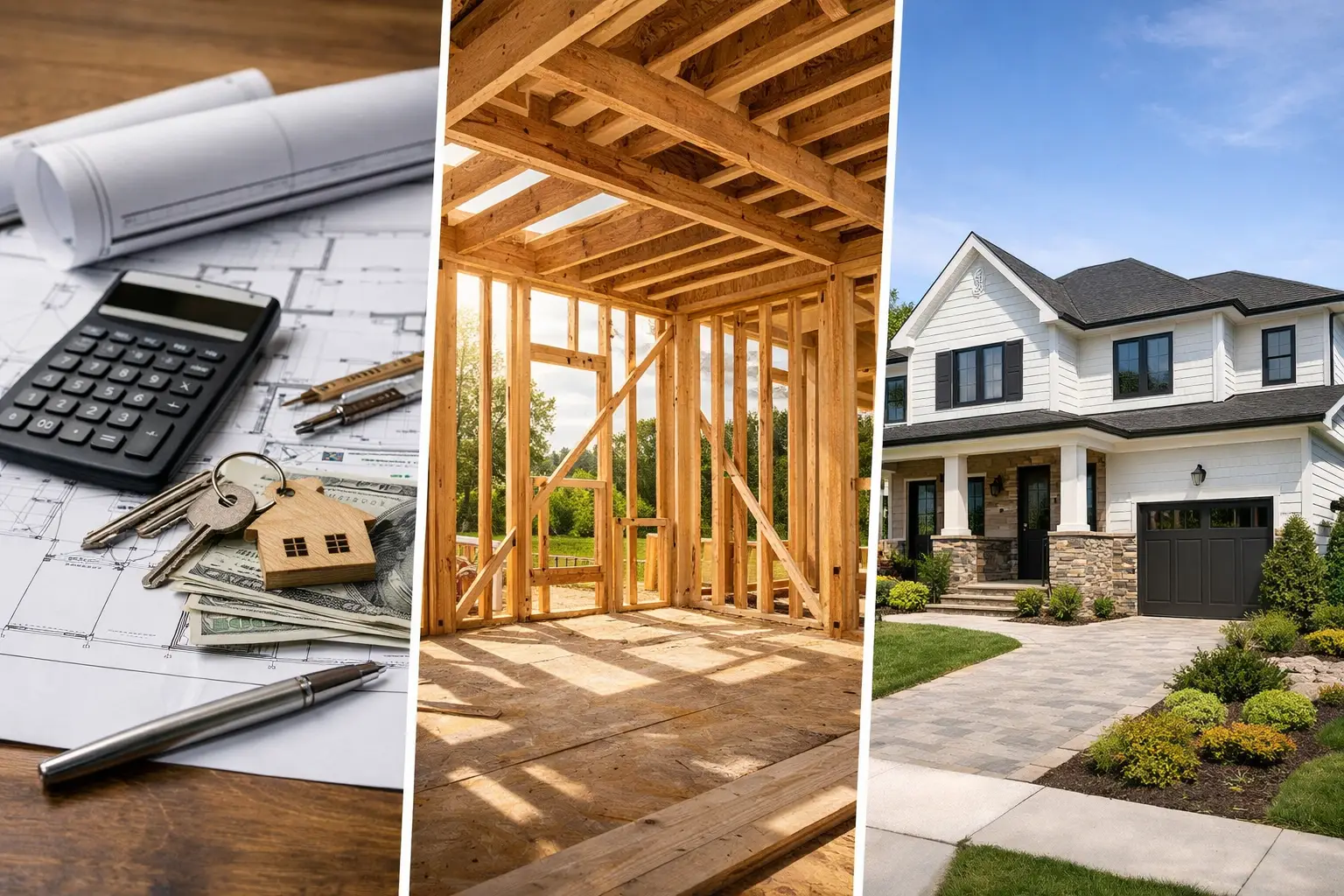
If you are figuring out how to finance a custom home build, the hard part is usually not the interest rate. It is the structure. A custom build is financed in phases, under lender controls, with inspections, draw schedules, contingencies, and appraisals that do not work like a standard purchase mortgage. If you get the structure wrong early, the project can stall before framing is done.
For New Jersey homeowners, that risk gets sharper because township approvals, utility coordination, and site conditions can move differently from one market to the next. A flat lot in Livingston is one thing. A sloped site in Alpine, a teardown in Short Hills, or an older property in Maplewood with utility surprises is another. Financing needs to match the actual build path, not the wishful version.
How to finance a custom home build without getting trapped later
Most custom homes are financed with a construction loan that converts to a permanent mortgage, or with a short-term construction loan followed by a separate mortgage at completion. Both can work. The better choice depends on your lot status, liquidity, risk tolerance, and how cleanly your plans and budget are defined before closing.
A one-time-close product can reduce repeat underwriting and limit one set of closing costs. The trade-off is less flexibility if your plans are still evolving. A two-time-close setup can be useful when the design is still moving or when rate strategy matters, but it adds another financing event later. For a homeowner building in towns with slower review cycles or more revision rounds, flexibility can matter more than convenience.
The lender is not just lending against a house. They are lending against a set of plans, a schedule of values, your builder agreement, and an appraised future value. That means the financing package has to be coherent on paper. If your architectural plans say one thing, your allowances suggest another, and your site budget is thin, underwriting gets harder fast.
Start with the full project cost, not just the house
A common mistake is treating the build cost as the construction contract alone. Lenders do not look at it that way, and neither should you.
Your total capital stack usually includes land or lot payoff, design and engineering, permits, demolition if needed, site prep, foundation work, utility connections, the vertical build, and a contingency reserve. In many NJ towns, soft costs are not minor. Survey updates, soil testing, stormwater requirements, and permit revisions can move real money. If you are building in a premium market with a teardown, carrying costs also matter because you may be paying to live somewhere else while the new home is under construction.
This is where engineering-led budgeting helps. A lender will be more comfortable with a budget that separates excavation, concrete, framing, roofing, windows, MEP rough-ins, insulation, drywall, millwork, tile, flooring, fixtures, paint, and final finish work than with a single broad number labeled construction. Granular budgets are easier to defend during underwriting and easier to manage during draw reviews.
The contingency is not optional
On paper, a 10 percent contingency often looks conservative to homeowners. In practice, it is just discipline. On a custom build, scope changes happen. So do site discoveries. Rock, drainage issues, utility upgrades, retaining needs, or township comments can all affect the job. In older NJ neighborhoods, even a straightforward teardown can bring surprises once you open the ground.
If you use every available dollar to maximize house size or finish level, you leave no room for reality. Lenders know this. Builders know this. Homeowners usually learn it mid-project if they ignore it.
The lot changes the financing strategy
If you already own the land free and clear, that equity may count toward your required contribution. If you still need to buy the lot, your loan structure may need to cover acquisition plus construction, and the lender will examine whether the combined numbers still support the completed value.
This is where custom home financing gets more technical than many borrowers expect. The lot is not just a line item. Its condition affects cost, schedule, and appraisal. A finished infill lot with utilities nearby is a different risk profile than raw land or a property needing major site work.
In parts of Essex, Union, and Morris counties, site conditions can change block by block. Mature trees, drainage patterns, narrow access, older utility infrastructure, and local zoning interpretation all affect the cost to build the same square footage. Financing should account for that before closing, not after the first draw request.
Appraisal drives more than most people realize
When borrowers ask how to finance a custom home build, they often focus on income, credit, and down payment. Those matter. But the appraisal can shape the whole deal.
For new construction, the appraiser is estimating future value based on plans, specs, and comparable homes. In established luxury markets, the challenge is not always finding expensive comps. It is finding truly comparable homes with similar quality, size, site condition, and level of customization. A highly tailored plan can be harder to support than a more market-standard layout, even if the finish package is strong.
That does not mean you should build for the appraiser. It means your financing should respect what the appraiser will need to justify. If the design is unusually specific, or if construction costs are rising faster than local resale data supports, you may need to bring in more cash than you expected.
Understand how construction draws actually work
Construction loans are not funded in one lump sum. Money is released in stages after milestones are completed and verified. The exact draw schedule varies, but it usually follows the sequence of site work, foundation, framing, rough systems, insulation and drywall, interior finishes, and final completion.
This matters because cash flow management becomes part of project management. Builders need a realistic schedule of values. Owners need to understand that lender inspections can affect timing. If a township inspection is delayed, or a draw request is missing paperwork, subcontractor sequencing can be affected.
In plain terms, the project has to be financeable month by month, not just in theory at the start. A clear draw schedule, consistent documentation, and line-item billing help keep the loan administration side from slowing down the field work.
Why builder documentation matters to lenders
Lenders typically review the construction contract, builder licensing and insurance, plans, specifications, budget, timeline, and experience. They want to know who is responsible for the work and whether the numbers are organized well enough to control disbursements.
That is one reason design-build can be easier to finance than a fragmented process. When the same team is coordinating design intent, estimating, sequencing, and field execution, there are fewer gaps between the plans and the budget. For homeowners, that usually means fewer surprises during underwriting and fewer change-driven financing issues once work starts.
Keep your personal finances cleaner than you think you need to
Construction lending is less forgiving than many standard purchase loans because the lender is underwriting both the borrower and the project risk. Large deposits, new debt, unexplained transfers, or major spending during underwriting can create friction.
If you are serious about building, keep your financial profile stable before and during the approval process. That means limiting new obligations, documenting assets clearly, and being realistic about reserves. A lender may approve the project, but a custom build still puts pressure on household cash flow. Rent, current mortgage payments, design invoices, permit fees, and upgrade decisions do not always line up neatly.
For dual-income households building in markets like Summit, Chatham, or Franklin Lakes, the issue is rarely whether they can afford the finished home on paper. The issue is whether they have enough liquidity to carry the project without making rushed decisions under pressure.
Choose financing around decision speed, not just rate
The cheapest money is not always the right money for a custom build. If your loan product is rigid, your appraisal assumptions are thin, or your lender is inexperienced with custom residential draws, a lower rate can end up costing you time and optionality.
A better lens is this: can the financing absorb normal construction realities without becoming the problem? Can it handle permit drift, weather delays, a foundation revision, or a finish decision that changes lead times? If not, the structure may be too tight.
That is why homeowners should line up their builder, architect, and lender earlier than they think. Financing a custom home works best when the design, budget, schedule, and underwriting package are built together. At Gus Skyy Co, that planning discipline is usually the difference between a project that moves with control and one that keeps getting renegotiated in the middle.
A custom home should be designed around how you want to live. The financing should be designed around how construction actually behaves.