
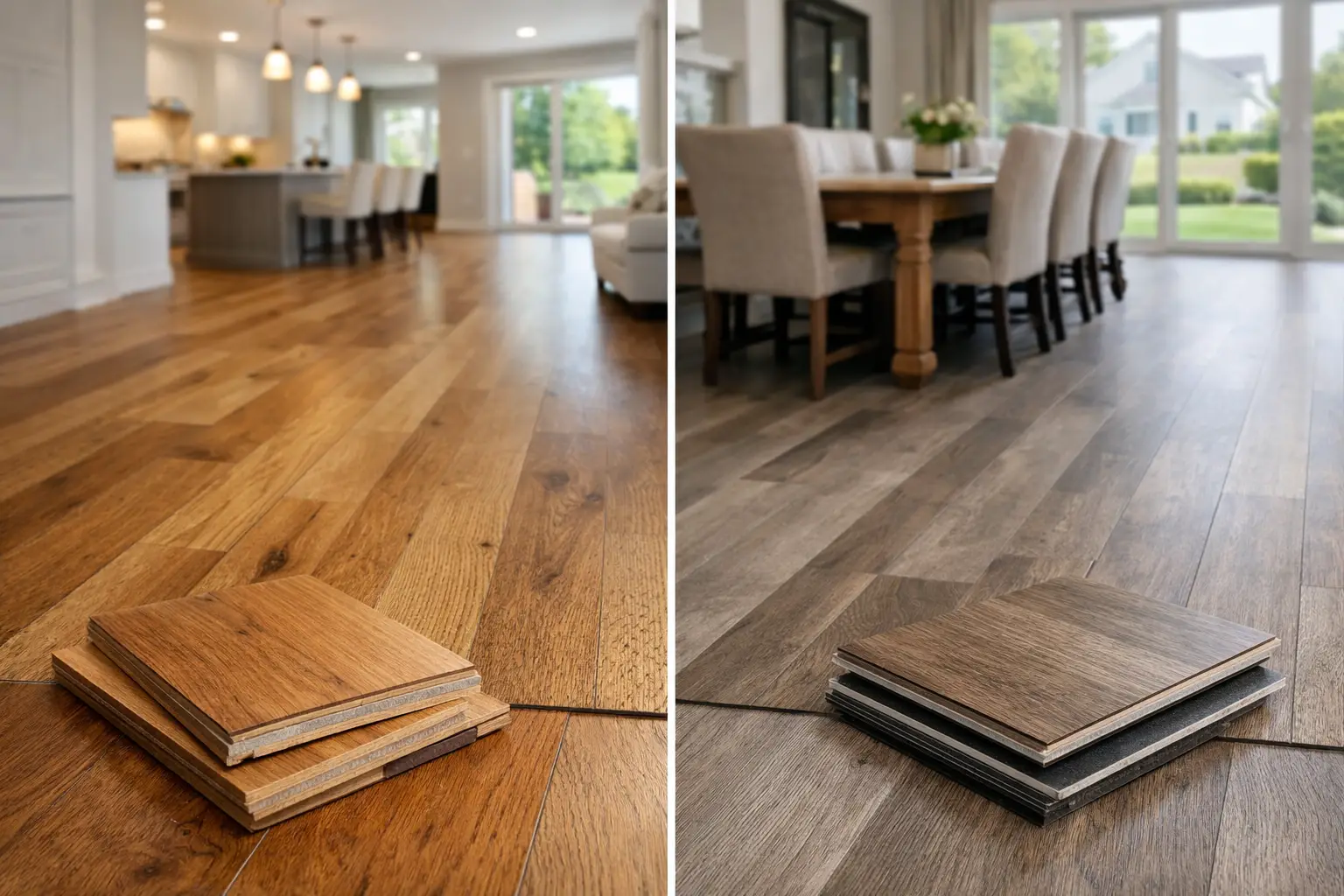
A floor decision usually looks simple from the sample board. Then real life shows up – a muddy dog run in Summit, a damp basement in Livingston, radiant heat in a Chatham addition, or kids dragging chairs across an open kitchen in Millburn. Hardwood vs vinyl plank is not really a style question first. It is a performance question tied to structure, moisture, traffic, and how long you plan to keep the house.
For most New Jersey homes, both materials can work. The right call depends on where the floor is going, what is under it, and what kind of maintenance tolerance the household has. We look at this the same way we look at framing or tile substrate – material choice should match site conditions, not just appearance.
Hardwood vs vinyl plank: what actually changes
The biggest difference is that hardwood is a natural wood product with a long service life and the ability to be refinished, while vinyl plank is a synthetic wear-layer product built for water resistance and easier day-to-day durability. That sounds basic, but it drives almost every trade-off.
Hardwood expands and contracts with seasonal humidity changes. In New Jersey, that matters. A house in Essex County can run dry in winter and humid in August, especially if the HVAC system is older or the home has inconsistent insulation. Solid hardwood reacts more than vinyl plank. That does not make hardwood a bad choice. It means the installation details, acclimation period, subfloor moisture readings, and expansion gaps matter a lot more.
Vinyl plank is less sensitive to moisture swings. In practical terms, that makes it attractive for basements, lower levels, mudroom-adjacent spaces, and renovation projects where subfloor conditions are not perfect. It is also quieter on the budget side of a whole-house renovation, especially when the goal is durability and speed rather than a fully traditional finish schedule.
Where hardwood makes more sense
Hardwood still wins in the rooms where permanence matters. In a primary living level, formal dining room, upstairs bedroom hall, or custom home main floor, real wood brings depth that vinyl has not fully matched. You see it in the grain variation, the way light reflects, and the fact that it can be sanded and refinished instead of replaced.
For higher-end homes in towns like Short Hills, Franklin Lakes, or Tenafly, hardwood also aligns better with buyer expectations in main living spaces. That does not mean vinyl kills resale. It means material choice should fit the level of the house. If the rest of the project includes custom millwork, upgraded windows, detailed stair work, and a serious kitchen package, a plastic-based floor on the entire main level can feel out of sync with the build.
Hardwood is also the better answer when continuity matters across decades. A properly installed white oak floor can be refinished multiple times. If a client wants a natural finish today and a darker stain eight years from now, hardwood gives that option. Vinyl plank does not. Once the wear layer is done or the style feels dated, replacement is the path.
That said, hardwood needs stable conditions. We do not recommend it casually in below-grade basements. We are careful with it in homes that have known moisture migration, older crawlspace issues, or unconditioned transitions. In pre-1978 homes, floor replacement can also intersect with lead-safe work practices if adjacent painted trim, radiators, or stair parts are being disturbed.
Where vinyl plank is the smarter material
Vinyl plank earns its place when the project needs toughness and moisture tolerance more than future refinishing. Finished basements are the obvious example. In parts of Bergen and Essex counties, basement slabs can test dry one season and show elevated moisture another, especially after heavy rain cycles. A material that tolerates that environment better is often the more rational choice.
It also works well in investment renovations, secondary family rooms, kids’ play areas, and homes with large pets. Chairs scraping, toys dropping, wet boots, and daily spills are less stressful on a good vinyl plank floor than on a site-finished hardwood floor with a more delicate finish.
Another factor is subfloor prep. Vinyl plank is not magic, and many failures come from people assuming it can hide a bad floor. It cannot. But in renovation conditions where you have slight irregularities, mixed existing substrates, or a need to control floor height transitions, vinyl can be easier to integrate than hardwood. That matters in additions and partial remodels where the old and new floor systems meet.
Moisture is the real deciding factor in many NJ homes
If you strip away design preferences, hardwood vs vinyl plank often comes down to moisture management. This is especially true in New Jersey, where we see a mix of older housing stock, finished basements, slab areas, and additions built across different eras.
Before choosing material, we want to know what the subfloor is doing. Plywood moisture content, slab readings, flatness, and the presence of previous water events matter more than the brochure. A beautiful floor installed over a wet or uneven substrate is just a delayed problem.
This is where engineering discipline helps. We are not looking only at the finish floor. We are looking at the assembly – joists, subfloor fastening, underlayment choice, transitions, and room-to-room elevation changes. If there is bounce in the floor, tile nearby, or a stair landing that must hit exact finish height, material selection affects more than appearance.
Appearance, acoustics, and feel underfoot
Hardwood usually feels warmer and more substantial underfoot. It sounds different too. The footfall is more solid, especially when installed over a properly prepared wood subfloor. In a quiet house, that matters.
Vinyl plank has improved visually, particularly in wider formats and lighter oak looks, but there is still a difference up close. Repeating patterns, flatter texture, and beveled edge profiles can give it away. In some homes that is irrelevant. In others, especially where natural materials are a core part of the design language, it stands out.
Acoustics depend heavily on the assembly. A floating vinyl plank floor over the wrong underlayment can sound hollow. Hardwood can squeak if the subfloor prep is weak. Neither material solves poor installation.
Maintenance and repair are not the same thing
Vinyl plank is easier to live with day to day. Regular sweeping and damp mopping are usually enough. Spills are less stressful. For busy households, that simplicity has real value.
Hardwood asks for more discipline. Water should not sit on it. Furniture protection matters. Finish wear in kitchen work zones is normal over time. But hardwood has one major advantage when damage accumulates: it can often be restored rather than replaced.
Repair logic is different too. With vinyl plank, replacing a damaged board in the middle of a floor can be straightforward or annoying depending on the locking system, layout, and whether extra material was saved. With hardwood, isolated repairs may blend well or may require sanding larger areas for consistency. Neither option is universally easier. It depends on the floor system and the age of the material.
Hardwood vs vinyl plank for resale
Resale conversations get oversimplified. Hardwood generally carries stronger perception in premium markets, especially on the main floor. Buyers know what it is, and they understand the long-term value. In that sense, hardwood still has an edge.
But vinyl plank is not automatically a downgrade. In a basement, a renovated lower level, or a practical family-focused layout, buyers often appreciate a floor that feels durable and low-maintenance. The mistake is using one answer for every room in the house.
A mixed-material strategy is often the best one. Hardwood upstairs and on the main living level. Vinyl plank in the basement or secondary spaces with moisture risk. That is not compromise for the sake of compromise. It is matching material performance to building conditions.
So which should you choose?
Choose hardwood if the space is above grade, the subfloor and humidity conditions are stable, and you want a floor that can age with the home. It makes the most sense in main living spaces, custom homes, and renovations where finish quality and long-term flexibility matter.
Choose vinyl plank if the space has moisture risk, heavy wear, or practical performance demands that outweigh the value of natural wood. It is often the more rational answer for basements, playrooms, some additions, and investment properties.
In our work across North and Central New Jersey, the right answer is usually not ideological. It is specific to the room, the substrate, and the life the house will actually see. A good floor is not the one that looks best in a sample rack. It is the one that still makes sense five years after move-in.