
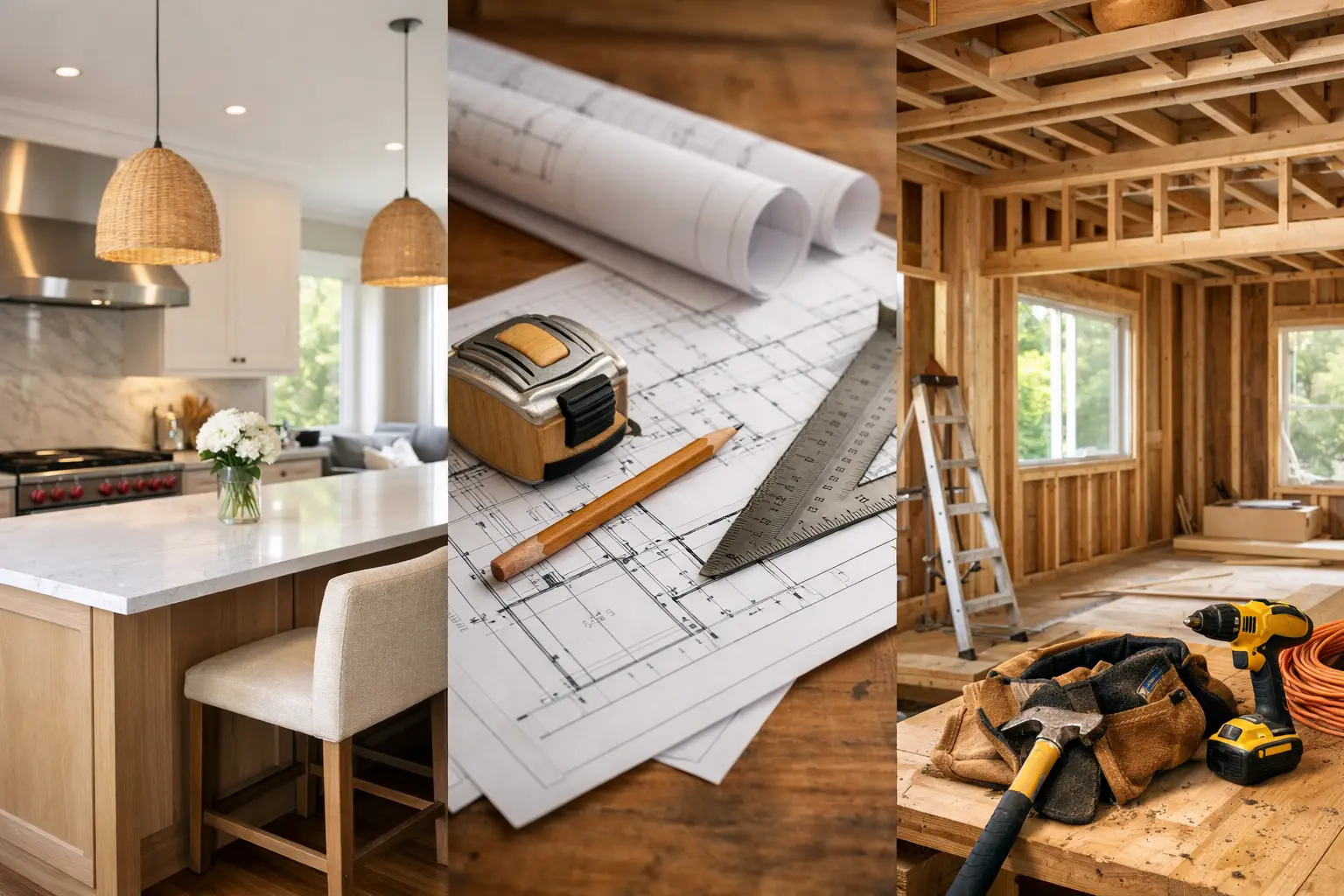
A whole-house renovation usually stops being a design conversation the first week walls open up. That is when the real job starts – structure, mechanicals, permits, sequencing, and the decisions that either protect your budget or quietly blow it up. This guide to whole home remodeling is written from that reality, not from a mood board.
In New Jersey, full-home renovation work is rarely just cosmetic. In pre-1978 homes in towns like Maplewood, Montclair, Westfield, and Glen Ridge, lead-safe practices may come into play. In older basements across Essex and Union counties, moisture and slab conditions affect flooring choices. In higher-end markets like Short Hills, Summit, Chatham, and Franklin Lakes, owners are often combining architectural upgrades with kitchen, bath, flooring, HVAC, and layout reconfiguration. That means the project has to be managed as one integrated system.
What a guide to whole home remodeling should start with
The first question is not finishes. It is scope. Are you remodeling for better daily function, resale positioning, long-term ownership, or a partial rebuild without moving? Those are different jobs, even if they use the same rooms.
A serious whole-home plan usually includes some mix of layout changes, kitchen and bath renovation, flooring replacement, electrical updates, insulation, HVAC work, window or door replacement, trim, paint, and often structural modification. If you are changing several of those at once, decisions have to be made in the right order. For example, there is no point selecting final flooring before you know whether the subfloor needs correction, whether plumbing lines will move, or whether the first floor needs leveling.
This is where many projects go sideways. Homeowners often price rooms separately, then discover those rooms are tied together by one electrical service upgrade, one permit path, one temporary protection plan, and one sequencing problem. A kitchen does not exist in isolation if the adjacent dining room wall is being removed and the hardwood runs through both spaces.
Start with constraints, not inspiration
Good planning starts by identifying what cannot be ignored. In New Jersey, that usually means structure, code, moisture, and municipal review.
If the home is older, verify whether the framing can support the changes you want. Opening a rear wall for a larger kitchen, relocating a stair, or combining small rooms into one open plan can trigger engineered beam work, point-load review, and foundation considerations. An engineering-led builder will look at load paths first, not after demolition.
Then look at the systems. Older homes in Livingston, South Orange, or Cranford may still have undersized electrical panels, aging drain lines, or ductwork that was never designed for current room layouts. Whole-home remodeling is the right time to address these items because access is available. It is also the wrong time to pretend they are someone else’s problem. Deferred system work becomes expensive once finishes are installed.
Municipal realities matter too. Permit review timelines differ by township. Inspection expectations can vary between Bergen, Essex, and Morris county municipalities. A design that works on paper still has to move through local review, utility coordination, and field inspections. If your builder treats permitting like paperwork instead of a schedule driver, expect friction later.
Budgeting a whole-home remodel without guessing
The cleanest budgets are line-itemized by scope package, not by vague room totals. That means separating demolition, framing, insulation, drywall, flooring, tile, cabinetry, countertops, plumbing fixtures, electrical fixtures, HVAC, paint, trim, and permit-related work.
Why does that matter? Because allowances hide risk. If you only see one broad number for a “primary bath remodel,” you cannot tell whether it includes substrate repair, waterproofing upgrades, valve replacement, niche framing, slab shower walls versus tile, or premium plumbing trim. On a whole-home project, those gaps compound fast.
A better approach is to distinguish three buckets early. First is fixed scope – work that is already visible and necessary. Second is allowance scope – finish selections not yet finalized. Third is contingency scope – conditions that may exist behind walls, under floors, or in mechanical rooms. That does not make a project more expensive by definition. It makes the decision-making more honest.
For homeowners in premium NJ markets, the biggest budgeting mistake is not overspending on finishes. It is underestimating infrastructure. Wide-plank hardwood, large-format tile, and custom cabinetry all perform better when the house underneath them is corrected properly.
Sequencing is where projects are won or lost
The practical side of a guide to whole home remodeling is sequencing. If the order is wrong, trades trip over each other, materials get damaged, and rework starts eating weeks.
A well-run project generally moves from investigation and design into permits, procurement, demolition, structural work, rough mechanicals, inspections, insulation, drywall, finish carpentry, cabinets, tile, painting, final flooring phases, punch, and closeout. The exact order shifts depending on scope, but the principle stays the same – dirty, invasive work first; precision finish work later.
There are trade-offs. Installing flooring too early can lead to damage. Installing it too late can complicate cabinetry, appliance clearances, and trim transitions. The right answer depends on material type, room sequence, and protection strategy. The same goes for painting before versus after finish installation. There is no universal shortcut.
Procurement deserves its own attention. Long-lead items such as custom windows, cabinetry, specialty tile, XL porcelain slabs, and certain plumbing fixtures can control the schedule more than labor does. If selections lag, the field schedule compresses. Then homeowners feel like the job suddenly got rushed, when the actual issue started months earlier in procurement.
Design decisions that age well
Whole-home renovation is where consistency matters more than trend. That does not mean everything should match. It means the house should feel intentional from room to room.
Start with flooring transitions, casing profiles, base heights, door styles, hardware finish families, and lighting temperature. These are the quiet details that make a renovation read as one complete project instead of a series of unrelated upgrades. In larger homes in places like Bernardsville or Saddle River, that continuity is especially important because sightlines are longer and room relationships are more obvious.
Material choice should also respond to conditions. Basements with a history of moisture are not always the place for site-finished hardwood. Some bathrooms need tile assemblies built for heavy use and movement control, not just a pretty wall tile. Kitchen slab selections should consider edge durability, maintenance expectations, and cabinet layout – not only color.
If you plan to stay in the home for 10 years or more, design for function at least as hard as for appearance. That means storage that is actually usable, circulation that works on school mornings, lighting that supports both task and ambient use, and bathrooms laid out around clearances instead of brochure photos.
Choosing the right builder for a whole-home project
A full-home remodel is not just a larger kitchen job. It requires estimating discipline, schedule control, field supervision, and technical decision-making across multiple trades at once.
Ask how scope is documented. Ask whether estimates are line-itemized. Ask who is managing your permits, who is supervising the site daily, and whether the crew structure relies on several layers of unknown subcontractors. Ask how change orders are handled and how unforeseen conditions are documented.
You should also ask technical questions. How are they evaluating structure before demolition? How do they approach lead-safe practices in older homes? What is their plan if the existing subfloor is out of plane by three-quarters of an inch across a first floor? How do they handle waterproofing assemblies in baths? The answers tell you whether you are dealing with sales language or actual construction management.
For NJ homeowners, local experience is not just about knowing nice neighborhoods. It is about understanding township permit flow, older housing stock, inspector expectations, weather exposure, and the difference between remodeling a 1920s colonial in Essex County and a newer home in Bergen County.
Living through the project
Some whole-home remodels can be phased while the owners stay put. Some should not be. If kitchens, multiple bathrooms, main flooring zones, and core mechanical systems are all offline at once, temporary living becomes less of a convenience issue and more of a project-control issue.
Phasing can reduce disruption, but it often adds duration and protection costs. Vacating the home can improve production efficiency, especially when large flooring runs, dust-generating demolition, and overlapping trades are involved. There is no pride in living through avoidable chaos if it compromises schedule or workmanship.
The best plan is the one that matches your actual tolerance for disruption, your household schedule, and the scope on paper. A family with young children and one working parent at home has a different threshold than an investor renovating a vacant property for resale.
One final point. The success of a whole-home remodel is usually decided before the first cabinet arrives. It is decided in scope definition, plan coordination, permit strategy, procurement timing, and whether the builder runs the work like a construction project instead of a collection of showroom selections. If you get those fundamentals right, the finishes have something solid to sit on.