
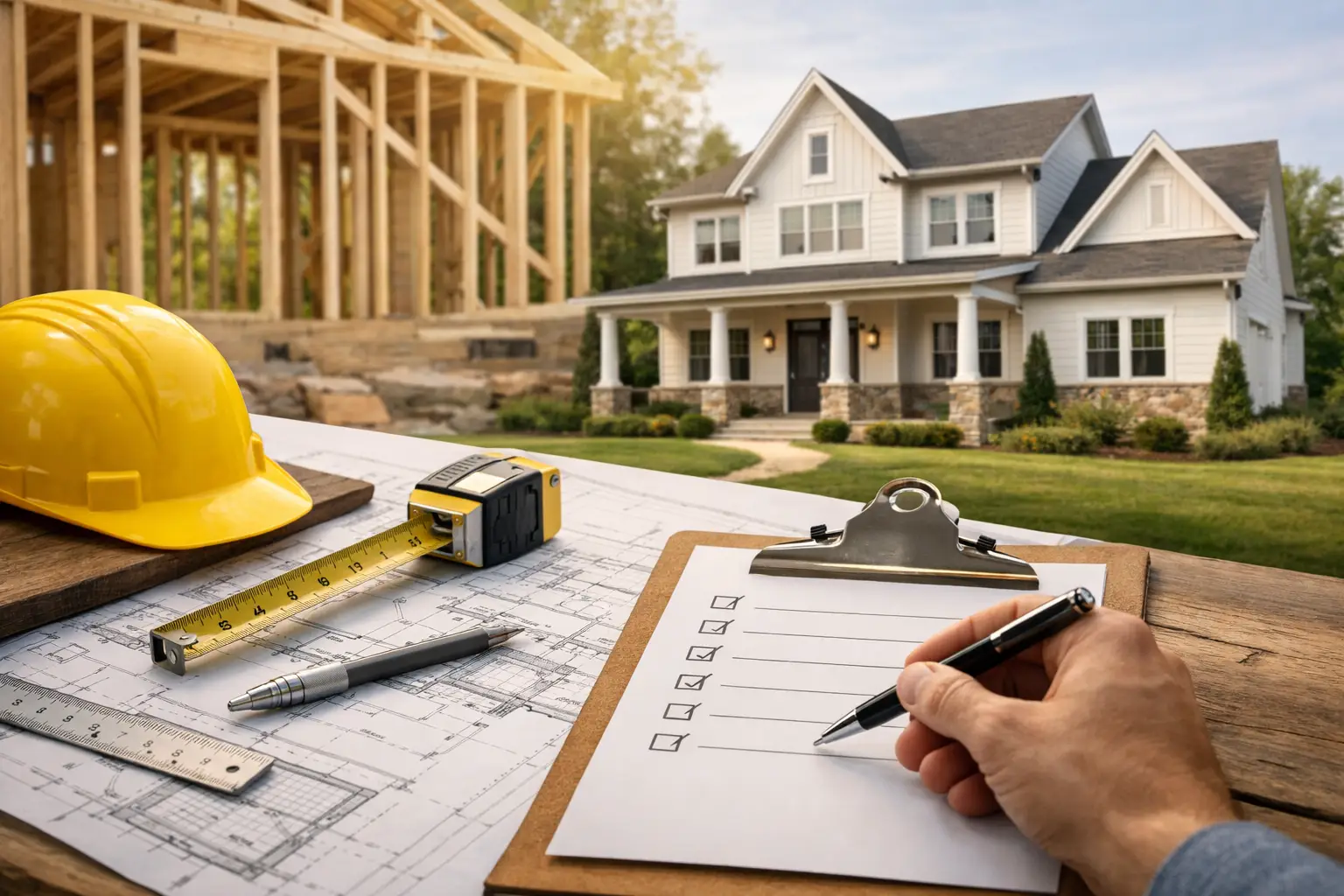
If you are planning a ground-up home in New Jersey, your custom home building checklist should start before anyone sketches a kitchen or prices a foundation. The early decisions control everything that follows – site feasibility, permit path, utility coordination, structural design, schedule risk, and how many change orders you invite into the job.
That matters more in NJ than many owners expect. A lot can change from one town to the next. A sloped lot in Short Hills is not the same project as a flat teardown in Warren. A basement plan that works on paper may not work once drainage, high water table conditions, or utility offsets show up in civil review. Good custom home planning is not about collecting ideas. It is about removing uncertainty in the right order.
A custom home building checklist starts with the lot
If you already own the property, this is where the real work begins. If you are still shopping, this is where expensive mistakes can still be avoided.
A buildable lot is not just about frontage and square footage. You need to know zoning setbacks, impervious coverage limits, grading constraints, easements, utility availability, and whether the house you want actually fits inside the legal envelope. In towns across Essex, Morris, Somerset, and Bergen counties, two lots with the same asking price can have very different construction paths.
Before design moves too far, confirm the survey, topography, flood considerations if applicable, and existing utility locations. If the home will have a basement, evaluate drainage early. In NJ, basement moisture problems usually begin outside the wall, not inside it. That means roof drainage, site grading, footing drains, waterproofing assembly, sump strategy, and discharge routing should be discussed as one system.
If the property has an older structure that will be removed, add demolition review to the checklist. Pre-1978 homes may involve lead-safe handling requirements. Tree removal, temporary utility disconnects, and township-specific demolition permits can also affect the pre-construction schedule.
Lock the scope before you chase numbers
Many homeowners ask for pricing too early, when the project is still a moving target. That usually produces a number that looks useful but is not reliable.
A disciplined checklist forces scope decisions before estimating gets treated as fact. Start with target square footage, bedroom and bath count, garage needs, finished basement or not, first-floor suite or not, and whether outdoor living areas are part of the initial build. Then define the construction level. For example, 5-inch white oak flooring, oversized aluminum-clad windows, full slab shower walls, and a high-output HVAC system are not small upgrades. They affect structure, mechanical planning, lead times, and procurement.
This is also where design-build has an advantage when it is run correctly. The estimator, designer, and field team are working from the same scope assumptions instead of passing partial information down a chain. That reduces the classic problem where a homeowner approves one set of expectations and the job gets built around another.
Build your professional team early
Your checklist should identify who is responsible for what before permit drawings begin. At minimum, most custom homes need architectural design, structural engineering, civil input where site work requires it, and a builder who can price and execute the actual scope shown on the plans.
In NJ, it also helps when the builder is used to local permit flow. One township may push zoning comments first and hold building review until those are cleared. Another may move faster on structural review but slow down on site approvals. Inspector expectations can vary too. That does not change code, but it changes how cleanly a project moves.
The best project teams solve coordination issues on paper, not in the field. If a large open-span rear elevation needs hidden steel, or a master bath layout conflicts with plumbing drops and beam depth, that should be caught before framing starts. Every unresolved intersection between architecture, structure, and MEP systems turns into time loss later.
Your permit and approval checklist needs to be realistic
Homeowners often underestimate how much pre-construction time gets absorbed by approvals. That is not poor planning. It is the actual process.
A useful checklist includes zoning review, architectural plans, structural plans, energy code compliance, septic or well coordination where applicable, utility applications, tree permits if required, soil import or export documentation if required by town, and demolition permits if an existing house is coming down. If the lot needs retaining walls, significant grading, or stormwater management, civil review becomes even more important.
Do not assume permit submission means immediate permit issuance. Comments, revisions, and resubmissions are normal. A builder who tells you this upfront is not being negative. They are respecting the process.
The interior selections checklist is bigger than most people think
This is where custom homes either stay organized or start bleeding time.
Selections are not just about appearance. They drive rough dimensions, framing backing, plumbing locations, electrical layout, HVAC registers, and installation sequencing. Your custom home building checklist should cover windows and exterior doors, roofing, siding or masonry, flooring, stair design, interior doors, trim package, cabinet layouts, appliances, plumbing fixtures, tile specifications, lighting, hardware, paint system, and any specialty items like radiant heat, smart home packages, or slab fireplaces.
The timing matters. A 48-inch range and hood decision affects venting and cabinet design. Large-format porcelain slab use in bathrooms or kitchens affects substrate prep and install sequencing. Wide-plank hardwood selection may affect subfloor flatness tolerances and acclimation planning.
If you want fewer delays, make decisions in the order the field needs them. Owners often spend weeks debating hardware finishes while window packages or HVAC equipment remain unresolved. That is backwards from a construction standpoint.
Budget control means line items, not allowances that float
A real checklist should help you compare numbers with less guesswork. That means line-item scope, clear inclusions, and written assumptions.
When owners review proposals, they should be able to answer basic questions. Is excavation based on known site conditions or a placeholder assumption? Are engineered floors, steel, insulation levels, and waterproofing assemblies clearly defined? Are tile installation standards, flooring materials, and trim levels identified in enough detail to compare one estimate to another?
Allowances are sometimes necessary, but too many allowances create false confidence. The more your project is defined before contract execution, the more useful the budget becomes. Engineering-led project management tends to help here because the estimate is tied to constructible scope, not just concept drawings.
Schedule planning should account for lead times and sequence
A custom home does not run on one master date. It runs on dozens of linked decisions.
Your checklist should flag long-lead items early. Windows, certain HVAC equipment, custom millwork, specialty plumbing fixtures, generators, and some imported tile or slab materials can affect the critical path. If those items are not selected and released on time, labor sequencing gets disrupted. That can mean idle gaps, resequencing, or temporary workarounds that cost more than the original delay.
Sequence matters just as much. Site work has to support foundation work. Foundation work has to support framing. Framing has to coordinate with MEP roughs. Waterproofing, insulation, drywall, flooring, finish carpentry, and final fixture install each depend on prior work being complete and correct. On a well-run project, every trade knows what is released, what is approved, and what is next.
Do not treat site conditions as a footnote
Some of the most expensive issues in custom building come from conditions that were either ignored or oversimplified.
In NJ, watch for rock, poor drainage, older utility connections, shallow or awkward sewer laterals, and site access limitations. A narrow lot in Montclair or Maplewood may present staging and parking constraints that do not exist on a wider property in Franklin Lakes or Saddle River. Teardowns in established neighborhoods may also require tighter neighbor protection, tree preservation measures, and more deliberate logistics.
For additions and rebuild scenarios, connect the checklist to the existing structure too. Floor elevations, foundation tie-ins, hidden framing conditions, and service upgrades can all change once walls are opened. This is one reason experienced builders avoid overpromising before investigation is complete.
Final walkthrough planning starts months before completion
A smart checklist does not end with finishes. It should include punch list standards, municipal inspections, certificate requirements, startup and commissioning for mechanical systems, attic and basement review, water management verification, appliance startup coordination, and final documentation.
Owners should also expect a closeout package that makes the home easier to maintain. That may include manuals, finish specifications, paint records, warranty details, and a clear record of installed systems. On a custom build, handoff should feel organized, not improvised.
One practical way to use this checklist is to review it at three points: before design starts, before permit submission, and before interior selections are finalized. Each review catches different risks. The first protects feasibility. The second protects scope. The third protects schedule.
The homeowners who get the best custom-build experience are usually not the ones who rush fastest into construction. They are the ones who make the project legible early, ask hard questions before work starts, and insist that design, estimating, permitting, and field execution all line up on the same set of facts.