
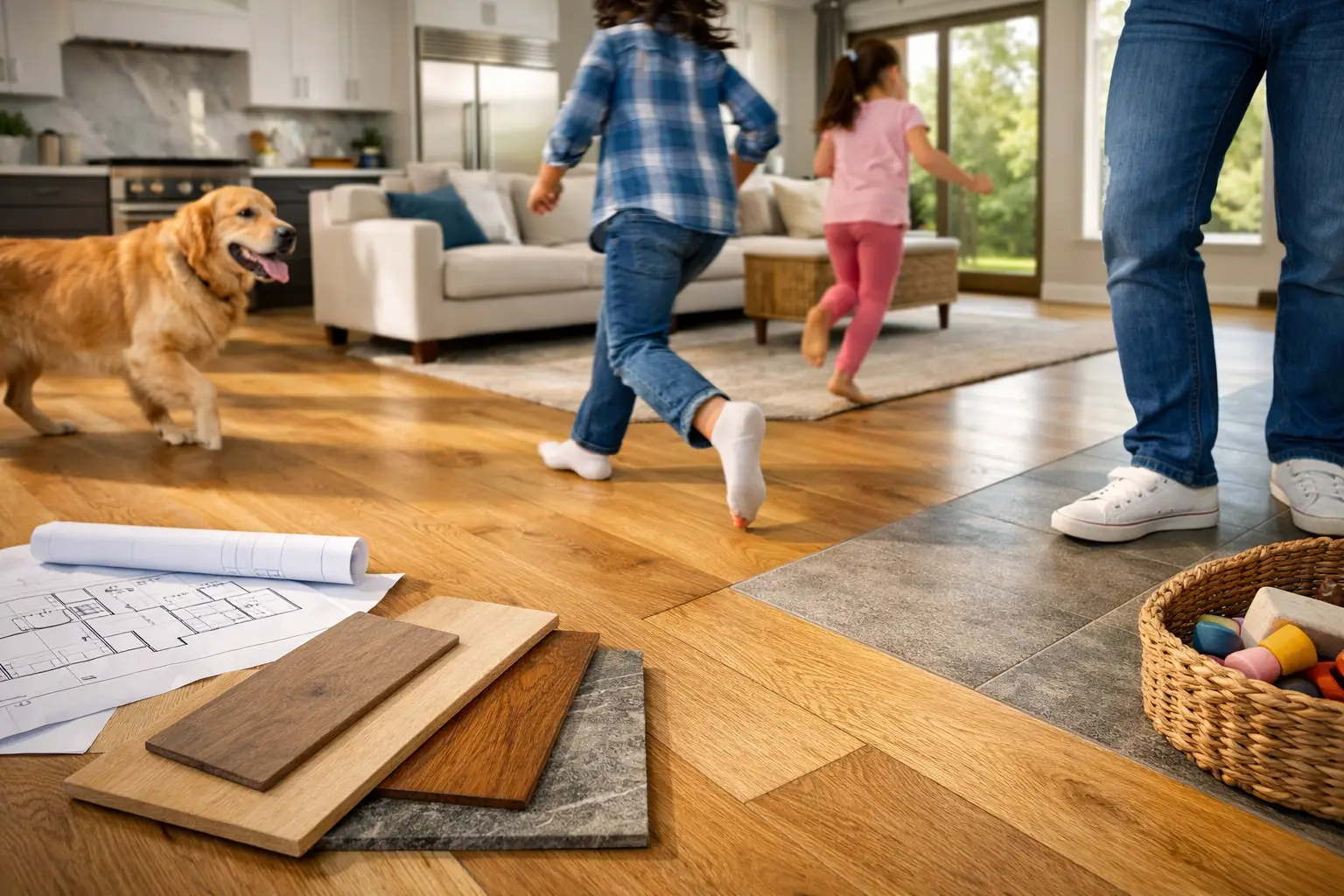
A wet soccer cleat at the back door, a dog bowl tipped beside the island, a rolling office chair in the guest room, and a dropped pan in the kitchen can tell you more about a floor than a showroom sample ever will. The best flooring for busy households is not one material for every room. It is the material that matches the traffic, moisture, subfloor, and maintenance habits in that specific part of the house.
For many New Jersey homes, the right answer is a planned mix: hardwood where appearance and long-term value matter most, porcelain tile where water is unavoidable, and luxury vinyl plank in spaces that need practical resilience without a cold surface. The wrong answer is selecting one product based only on color, then discovering it was never suited to the room.
What Busy Households Actually Need From a Floor
“Durable” is too vague to make a useful flooring decision. A family in Livingston with two dogs and three children needs resistance to scratching and tracked-in water. A Millburn homeowner renovating a kitchen needs a floor that can handle spills, chair movement, and the transition into adjoining rooms. An investor preparing a rental may prioritize replaceable materials and consistent availability.
Start with four conditions: water exposure, impact and abrasion, room-to-room continuity, and the existing subfloor. These conditions determine performance more reliably than a product label.
Water is the first filter. Powder rooms, laundry rooms, mudrooms, basement slabs, and entrances need materials that do not swell or lose their shape when moisture gets past the surface. Impact is different. A porcelain tile floor resists scratches exceptionally well, but a dropped heavy glass or dish may break on it more easily than on resilient flooring. Hardwood can be refinished, but it will show dents and scratches sooner than tile or many LVP products.
The subfloor matters just as much. Older Essex County homes often have wood-framed floors with movement, patched areas, or uneven transitions from prior renovations. Basement floors in Morris and Bergen counties may have moisture vapor coming through a concrete slab. Before material selection is final, the installer needs to measure flatness, inspect for movement, test moisture where required, and identify height changes at stairs, exterior doors, and existing rooms.
Best Flooring for Busy Households, Room by Room
Hardwood for main living spaces
Hardwood remains a strong choice for living rooms, dining rooms, hallways, and bedrooms in premium New Jersey homes. It has a visual depth that printed materials do not fully replicate, and it can be refinished when wear accumulates. For a whole-home renovation in Short Hills, Summit, or Chatham, hardwood can also create continuity across public spaces and make a future kitchen update easier to coordinate.
The trade-off is honest: hardwood is not waterproof. Pet nails, sand from the driveway, and spilled water will leave evidence over time. That does not make it a poor choice. It means the species, finish, and board width should be selected with real use in mind. A matte or low-sheen finish hides small scratches better than a glossy floor. A natural variation in wood grain can also make daily wear less obvious than a very uniform stain.
Engineered hardwood is often the more practical option when installation height, wider planks, or subfloor conditions make solid wood less suitable. It is still wood at the surface, so it requires the same respect around standing water. Do not treat it like vinyl in a mudroom.
Luxury vinyl plank for active, spill-prone zones
Luxury vinyl plank, commonly called LVP, is a practical fit for active family rooms, lower levels, playrooms, laundry-adjacent spaces, and many kitchens. It is comfortable underfoot, quieter than tile, and more forgiving when something falls. Quality LVP also offers strong resistance to ordinary household water exposure.
Not all LVP performs the same way. Wear layer thickness, locking system, core construction, texture, and plank stability affect how it looks and holds together. The product must also be installed over a floor that meets the manufacturer’s flatness requirements. A floating floor can telegraph subfloor dips, separate at joints, or feel hollow if preparation is skipped.
LVP is not indestructible. Sharp furniture feet, heavy appliances moved without protection, and direct sun can create problems. In a room with large south-facing windows, review the manufacturer’s temperature and sunlight guidance before choosing a dark plank. In a busy household, use protective pads under furniture and keep grit off the floor. Sand is more damaging than most families expect.
Porcelain tile for water and hard use
Porcelain tile is the workhorse for bathrooms, mudrooms, laundry rooms, and entries. It does not absorb water like wood-based flooring, handles heavy foot traffic well, and is easy to clean after rain, snow, or pet messes. In homes near the shore or in areas where winter slush comes through the garage entry, that water resistance has real value.
Large-format porcelain can create a clean, modern look with fewer grout joints. It also demands better substrate preparation. Large tiles do not hide an uneven floor. If the floor is out of plane, tile edges can sit unevenly, creating lippage that is visible in side light and noticeable underfoot. The tile layout, grout-joint size, and transition heights should be decided before installation begins, not after materials arrive.
For bathrooms, choose a tile with appropriate slip resistance for the floor. A polished tile may look sharp on a wall but can be a poor decision on a wet shower floor or near a tub. Smaller mosaic tile in a shower pan often gives better traction because the additional grout lines create grip.
Waterproof flooring for basements, with moisture planning first
A finished basement is not simply another first-floor room. Concrete can release moisture even when the basement looks dry. That is especially common in older homes with changing drainage conditions, seasonal groundwater, or slab cracks that were covered during a previous renovation.
Porcelain tile and properly selected vinyl flooring are common basement choices, but neither eliminates the need to evaluate moisture. Adhesive systems, underlayments, and floating-floor assemblies have different requirements. If there is active water intrusion, correct that condition before installing finish flooring. A new floor cannot solve a drainage problem.
Carpet can still work in a dry, conditioned basement media room or bedroom area, but it is rarely the first recommendation for a space that has had water events. If comfort is the goal, area rugs over resilient flooring provide a more manageable option.
Do Not Ignore Transitions, Doors, and Floor Height
The material cost is only part of a flooring scope. A successful installation also accounts for what happens where one floor meets another. That includes stair nosings, flush or reducer transitions, baseboards, door casings, appliance clearances, and exterior door thresholds.
A common mistake is installing a thicker floor over an existing layer without checking the front door swing, dishwasher opening, or the first riser at the stairs. Building codes and safe stair geometry can be affected when floor heights change. In a whole-home renovation, these details should be reviewed alongside the layout, not handled as last-minute trim work.
Pre-1978 homes add another consideration. Removing old flooring may disturb adhesives, paint, or other materials that require proper lead-safe work practices. The demolition plan should be clear before the project starts, especially when children will remain in the home during portions of the renovation.
A Straightforward Selection Method
Choose flooring in this order: confirm the room’s exposure to water and traffic, inspect the substrate, establish the finished-floor heights, then narrow the visual options. This prevents a beautiful sample from becoming an expensive compromise.
For a typical busy household, hardwood in dry living areas, porcelain in wet rooms, and LVP in high-activity secondary spaces is often the most balanced combination. But there are exceptions. A household with large dogs may prefer LVP throughout the first floor. A homeowner focused on a continuous traditional finish may accept the maintenance needs of hardwood and use runners at entries. A minimalist home with radiant heat may lean toward porcelain across broader areas.
At Gus Skyy Co, flooring scopes are evaluated as part of the room and the building, not as boxes of material waiting to be installed. That means checking substrate conditions, transitions, moisture exposure, and the work that must happen before the finished floor goes down.
The right floor should make daily life easier without forcing your home into a style that does not fit. When you are ready to compare materials against your actual rooms and subfloor conditions, request an itemized estimate through the Gus Skyy Co estimate page.