
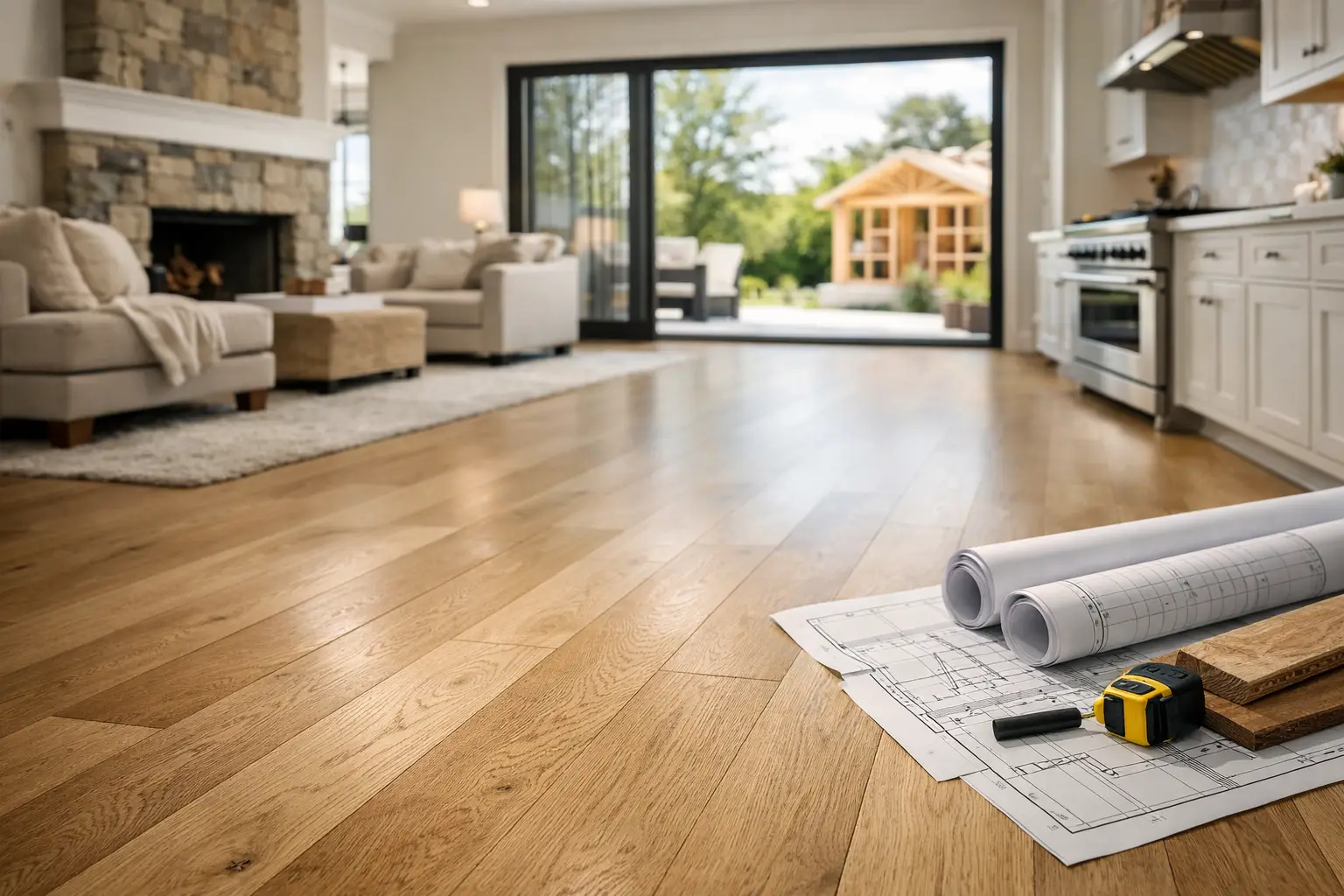
A floor can look excellent in a showroom and still be the wrong product for a Short Hills kitchen, a Montclair colonial, or a finished basement in Livingston. The useful part of an engineered hardwood flooring review is not whether a plank photographs well. It is whether its construction, wear layer, finish, and installation method fit the room underneath it.
Engineered hardwood is a real-wood floor. Its top layer is hardwood veneer, not a printed image, bonded to a built-up core. That core makes it more dimensionally stable than solid hardwood when indoor humidity changes. It does not make the floor waterproof, maintenance-free, or suitable for every slab. Those distinctions matter in New Jersey, where winter heating dries homes out, summer humidity returns quickly, and below-grade moisture is common.
What Engineered Hardwood Actually Delivers
For main-level living areas, bedrooms, hallways, and many kitchens, engineered hardwood offers the appearance and feel of wood with more flexibility than site-finished solid flooring. Wider boards are generally more realistic for renovations where homeowners want a clean, continuous look through an open kitchen, dining room, and family room.
The advantage comes from the core. A well-built plank uses multiple layers of plywood arranged with alternating grain direction. This resists the seasonal expansion and contraction that can cause solid wood to cup, gap, or move more noticeably. A quality engineered floor can often be installed over properly prepared plywood subfloors and, depending on the product, over concrete slabs.
But “engineered” describes a category, not a performance guarantee. One product may have a thick white oak wear layer over a stable plywood core. Another may have a thin veneer over a fiberboard core and a finish that shows scratches quickly. Both are engineered hardwood. They should not be evaluated as equal.
Engineered Hardwood Flooring Review: The Specifications That Matter
The sample board tells only part of the story. Before selecting a product, review the written specifications and installation instructions. They determine where the floor can go and how it should be installed.
Wear Layer Thickness Determines Repair Options
The wear layer is the real hardwood on top of the plank. A 2 mm wear layer can be appropriate for a lower-traffic room or a project where refinishing is unlikely to be needed. A 3 mm to 4 mm wear layer gives more practical room for future screening or refinishing, provided the manufacturer permits it. Thicker wear layers generally offer better long-term flexibility, but they are not a substitute for a durable factory finish.
For an active household with a dog, children, or regular entertaining, look at both the wear layer and the finish system. Matte finishes and textured surfaces can disguise everyday scuffs better than smooth, dark, high-gloss boards. They will still dent if something heavy is dropped. Wood is wood.
Core Construction Affects Stability
Multi-ply plywood cores are usually the stronger choice for installations involving changing humidity, wider planks, or transitions between rooms. They also tend to hold fasteners more reliably for nail-down or staple-down installation when the product is approved for it.
High-density fiberboard cores can perform well within their stated limits, but they need tighter moisture control. They are less forgiving if water sits at a dishwasher leak, patio door, or pet bowl. For a first-floor kitchen in Summit or a mudroom near an exterior entry, that is not a minor detail.
Plank Thickness Is Not Just a Feel Underfoot
Total plank thickness affects transitions, stair nosing coordination, door clearances, and how the floor meets existing tile or stone. In a whole-home renovation, a difference of a few millimeters can determine whether adjacent rooms need underlayment changes or transition strips.
This is where product selection should happen alongside the renovation plan, not after cabinets, interior doors, and tile heights are locked in. Flooring is a finish material, but it affects several construction details before the finish stage begins.
Where Engineered Hardwood Makes Sense in a New Jersey House
Engineered hardwood is often a sound choice for above-grade floors and for lower levels that are dry, conditioned, and verified to meet the flooring manufacturer’s moisture requirements. It can also be a good choice over radiant heat if the specific product is rated for it and the heating system follows the manufacturer’s temperature and startup limits.
For a basement, the answer depends on the slab, drainage history, humidity control, and the intended use of the space. A basement that has taken on water, shows elevated moisture readings, or relies on a dehumidifier just to remain comfortable should not receive wood flooring simply because a product says it can be glued to concrete. Luxury vinyl plank or porcelain tile may be the more rational finish in that room.
Kitchens require the same honest assessment. Engineered hardwood works in many kitchens, especially when the homeowners want continuity with surrounding rooms. It is not the right expectation if the goal is a floor that tolerates standing water without consequence. Appliance leaks and overflowing sinks need prompt cleanup.
Installation Is Where Good Material Can Still Go Wrong
A premium plank cannot correct a wet slab, an uneven subfloor, or skipped prep work. Installation requirements vary by manufacturer, but the basic checks are consistent: moisture testing, subfloor flatness, acclimation where required, correct adhesive or fasteners, expansion space, and proper transitions.
Subfloor flatness matters more with wider boards. A typical specification may call for the floor to be within 3/16 inch over 10 feet, though the product instructions control. If the subfloor has humps or low areas, boards can flex, edges can become more visible, and joints can work loose over time. The correct fix is preparation before flooring arrives, not forcing planks flat during installation.
Concrete needs special attention. Moisture must be tested using the method and limits specified by the flooring manufacturer and adhesive system. A visually dry slab is not a moisture test. In Essex and Bergen County homes, we routinely see lower-level slabs that look fine until flooring prep begins and existing finishes are removed.
Installation method also changes the result. Nail-down or staple-down installation is common over suitable wood subfloors. Glue-down installation can be appropriate over concrete and can reduce the hollow sound associated with some floating floors. Floating installation can work for approved click products, but it needs a flat surface, correct underlayment, and well-planned transitions. There is no single “best” method without looking at the structure and product.
In homes built before 1978, floor removal can also disturb old coatings, adhesives, or painted trim. An EPA Lead-Safe Certified Firm follows the appropriate containment and work practices when the scope triggers them. That should be discussed before demolition, not discovered after dust has spread through an occupied home.
Finish, Color, and Width: The Decisions Homeowners Feel Later
Natural white oak and warm neutral stains remain flexible choices because they work with changing wall colors, cabinetry, and furniture. Very dark floors can look dramatic, but they show dust, scratches, and pet hair faster. Very pale floors can also reveal grime at high-traffic entries. The right color is partly aesthetic and partly a maintenance decision.
Wide planks create a quieter visual field and suit the proportions of many newer additions and renovated colonials in Chatham, Madison, and Millburn. They demand better subfloor preparation than narrow strips. Long boards also create more waste around angled rooms, fireplaces, stair openings, and irregular layouts. A layout plan should account for these conditions before material quantities are finalized.
Hand-scraped or heavily textured boards can hide minor marks, but the texture collects more dust and can complicate spot repairs. Smooth boards are easier to clean and give a more tailored appearance. Neither choice is objectively better. It depends on the household and how the room is used.
Questions Worth Asking Before You Approve the Floor
Ask for the product’s wear-layer thickness, core type, approved installation methods, refinishing guidance, radiant-heat approval, and moisture limits. Confirm whether the selected stair nosing, reducers, and transitions match the flooring line. Also ask how the installer will address subfloor leveling, slab moisture testing, and baseboard or shoe-molding details.
A flooring proposal should separate material selections from necessary prep conditions. That is not overcomplication. It prevents a homeowner from assuming a square-foot price includes correcting a subfloor that only becomes visible after old flooring is removed.
At Gus Skyy Co, flooring scopes are reviewed against the actual substrate, adjacent finish heights, room use, and manufacturer requirements before installation is scheduled. That calculation-first approach is particularly valuable when engineered hardwood ties into tile, new cabinetry, or a larger kitchen and bath renovation.
The Bottom Line for NJ Homeowners
Engineered hardwood earns its place when you want real wood, wider planks, and better dimensional stability than solid hardwood can offer in a changing indoor climate. Choose the product for its full construction, not just its color sample. Then give it the dry, flat, properly prepared surface its warranty and long-term appearance require.
If you are planning flooring as part of a renovation or addition, request an estimate through the Gus Skyy Co Estimate page. The most useful flooring decision is the one that still makes sense after the kitchen is finished, the furniture is back, and the first New Jersey summer humidity arrives.