
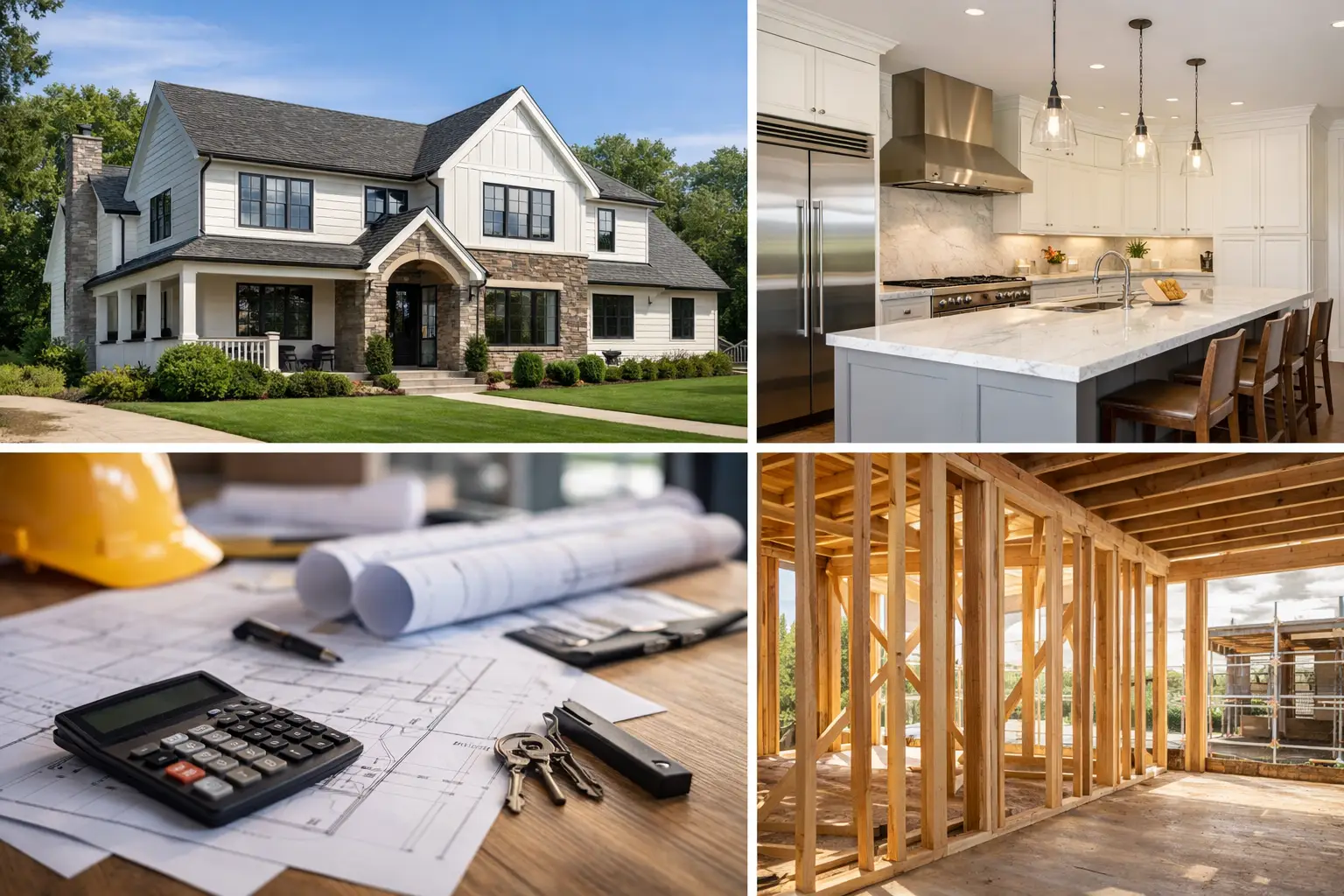
A full gut in Maplewood is not priced the same way as a cosmetic update in Summit. That is the first thing to understand about whole house renovation cost. In New Jersey, the number moves fast based on house age, existing conditions behind the walls, township requirements, and how far you are pushing the finish level.
Homeowners usually start with a broad question – what does it cost to renovate the whole house? Builders usually answer with another question – what exactly are we renovating? That is not evasion. It is how you avoid a bad budget from day one.
What drives whole house renovation cost
The biggest cost driver is scope. A house that keeps its layout, mechanical locations, and most wall surfaces is a different project from a house that gets reconfigured, opened up structurally, and rebuilt room by room. Both are called whole-home renovations. They do not belong in the same budget bucket.
In practical terms, there are three broad levels. A surface-level renovation might include flooring, paint, trim, interior doors, fixture swaps, and selective kitchen and bath updates. A mid-level renovation usually adds new kitchens, full bathroom rebuilds, some electrical and plumbing updates, and more finish work across the house. A major renovation often includes structural changes, all-new mechanical systems, insulation, windows, roofing coordination, and code-related upgrades that come with opening walls and ceilings.
Square footage matters, but not in a simple linear way. A 2,000-square-foot colonial with one kitchen and two baths may cost more per square foot than a 4,000-square-foot house if the smaller house needs full system replacement, foundation moisture correction, and lead-safe work practices. Older homes in Essex, Union, and parts of Morris County often carry those hidden conditions.
Cost ranges by renovation level
For planning purposes in New Jersey, a light whole-home refresh often starts around $100 to $175 per square foot. A more substantial renovation with kitchens, baths, flooring, tile, lighting, and selective layout changes often lands around $175 to $300 per square foot. A full-scale redesign with structural engineering, new systems, premium finishes, and significant reconfiguration can exceed $300 per square foot.
Those are not quote numbers. They are planning ranges. The difference matters.
A 2,500-square-foot home at $175 per square foot and the same home at $325 per square foot are two entirely different projects. The first may preserve much of the shell and system layout. The second may involve steel beams, all-new HVAC zones, upgraded service, custom millwork, slab tile installation, waterproofing corrections, and township review cycles that add real cost.
Why older NJ homes swing the budget
Prewar colonials, split levels from the 1950s and 1960s, and pre-1978 homes create budget volatility. Once demolition starts, you may find knob-and-tube remnants, undersized panels, ungrounded circuits, cast iron waste lines, sagging joists, or moisture-damaged subfloors. If the property was modified over decades, you may also find framing that does not match current structural expectations.
Lead paint is another NJ reality in older housing stock. If a home was built before 1978 and painted surfaces will be disturbed, lead-safe containment and handling are not optional. That affects labor flow, debris handling, and staging.
Basements also change cost more than most owners expect. In towns with older foundations, we often see moisture intrusion, efflorescence, previous patch repairs, and floor slab movement. If you are renovating the whole house, basement conditions are not separate from the rest of the budget. Moisture below affects flooring, insulation, framing, and air quality above.
Kitchens and baths carry the budget
If you want to understand whole house renovation cost, follow the wet rooms. Kitchens and bathrooms concentrate plumbing, electrical, tile, waterproofing, cabinetry, ventilation, and finish coordination in small areas. They are usually the most expensive rooms per square foot.
A house with one dated kitchen and three original bathrooms can absorb a large share of the renovation budget before you touch the rest of the home. Add layout changes – moving drains, relocating appliances, expanding shower footprints, or reframing walls – and the cost rises again.
Tile selection matters too. Standard ceramic field tile installs differently than large-format porcelain. XL slabs require flatter substrates, more handling labor, and tighter planning around cuts, corners, and fixture penetrations. The same goes for flooring. Site-finished hardwood, prefinished hardwood, LVP, and large-format tile all hit labor and prep differently.
Systems upgrades are where estimates get honest
Homeowners often budget for what they can see. Builders have to budget for what the house needs to function. That is why system upgrades reshape the number.
Electrical work can include panel replacement, service upgrades, AFCI and GFCI protection, recessed lighting layouts, kitchen circuits, bathroom exhausts, EV charging prep, and low-voltage coordination. Plumbing may involve replacing old supply lines, waste stacks, water heater changes, or rerouting to support a new floor plan. HVAC can shift from basic replacement to a full redesign if the existing ductwork is undersized or if the renovated layout changes room loads.
These are not glamorous line items, but they are what make a full renovation perform properly after move-in. In engineering-led project planning, system integrity is not treated as an add-on after finishes are selected.
Permits, inspections, and township friction
Permit cost is usually not the biggest number, but permit process affects schedule and schedule affects cost. Some New Jersey townships move drawings and inspections faster than others. Some inspectors focus heavily on fire blocking, stair geometry, and framing details. Others scrutinize electrical service and HVAC documentation more closely.
That matters when you are planning temporary housing, financing draws, material lead times, or school-year move-back dates. A renovation in Bernardsville does not move exactly like one in Montclair or Westfield. The project team should account for local approval patterns early, not after demolition begins.
Design choices that quietly raise the price
Owners usually expect custom cabinetry or premium appliances to raise cost. Less obvious upgrades do it too. Flush base details, level-five wall finish, hidden linear drains, oversized pivot doors, radiant heat in multiple baths, wide-plank hardwood over corrected subfloors, and complex lighting control all add labor and coordination.
There is nothing wrong with those choices. The issue is making them intentionally. Many over-budget projects are not driven by one big luxury item. They are driven by twenty smaller decisions made without a running line-item budget.
How to budget without fooling yourself
Start with the full scope, not the idealized scope. If you know the kitchen, baths, flooring, windows, HVAC, and electrical panel all need work, put them on the table at the beginning. Partial budgeting creates false confidence and usually leads to reactive decisions later.
Carry a contingency, especially in older homes. If walls stay closed and systems remain untouched, contingency pressure may be low. If the project involves demolition in a 1920s or 1950s house, the risk profile is different. Unknowns live in framing pockets, under tile beds, behind plaster, and below finished basement walls.
It also helps to separate must-do work from optional upgrades. Structural corrections, waterproofing, code compliance, and failing systems belong in one category. Finish upgrades and layout enhancements belong in another. That approach lets you protect the house first and improve it second if budget tension appears.
Why line-item estimating matters
A whole-home renovation is too expensive to price as a vague allowance. Owners need to see where the money is going – demolition, framing, insulation, roofing coordination, plumbing, electrical, HVAC, flooring, tile, trim, paint, cabinetry, countertops, permits, and waste removal.
That level of detail does two things. First, it gives you a realistic planning tool. Second, it exposes trade-offs early. If you want to move budget into a larger kitchen island, you can see what has to give elsewhere. If your house in Short Hills needs structural beam work to open the first floor, you can make that decision with numbers instead of guesswork.
This is where a design-build process tends to help. When design, structural thinking, selections, and construction planning happen together, the estimate usually gets sharper before the job starts. That reduces the kind of mid-project surprises that come from pricing unfinished ideas.
The right question is not just cost
The better question is whether the renovation scope matches the house, the neighborhood, and your hold period. A family planning to stay in Chatham for fifteen years can justify different decisions than an investor repositioning a property for resale in Union County. A house in Alpine or Franklin Lakes may support a very different finish package than a rental-grade renovation in another market.
Whole house renovation cost is a real concern, but the smarter lens is cost relative to outcome. Are you correcting structural and system issues permanently? Are you building a layout that works for how you live now? Are you selecting materials that fit the use case and the property value? That is how experienced owners protect both budget and result.
At Gus Skyy Construction, that conversation usually starts with scope definition, existing-condition review, and a line-item framework that shows what is driving the number. That is less exciting than a low teaser price, but it is how serious renovations get planned properly.
If you are pricing a whole-home project, the goal is not to chase the smallest number. The goal is to understand which number actually belongs to your house.