
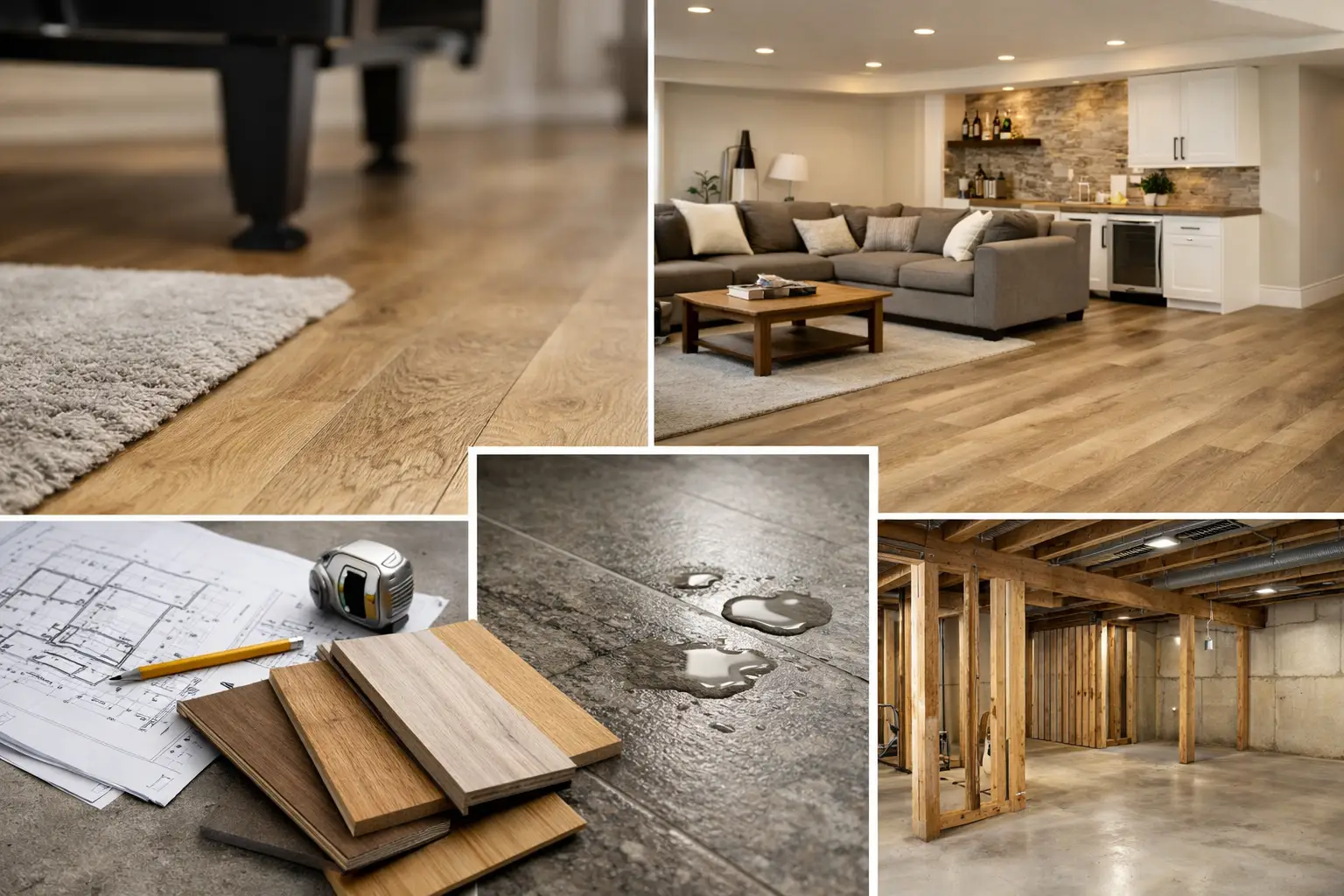
A finished basement can look perfectly dry in July and still take on enough seasonal moisture in January to ruin the wrong floor. That is why choosing the best flooring for basements is less about style first and more about moisture behavior, slab conditions, and how the space will actually be used. In New Jersey, especially in older homes across Essex, Union, Morris, and Bergen counties, that decision needs to be made with real field conditions in mind.
Basements are different from above-grade rooms in one basic way. They are in contact with concrete, soil pressure, and temperature swings. Even when there is no active water intrusion, the slab can transmit vapor. The air can feel dry while the floor assembly below is not. That is where many basement flooring failures start.
What actually makes the best flooring for basements
The right basement floor has to handle three things at the same time. First, it must tolerate moisture or at least not be damaged by normal slab vapor. Second, it has to work with the flatness and condition of the concrete below. Third, it needs to match the room use, whether that is a gym, playroom, guest suite, home office, or a lower-level family room with a walkout.
A lot of homeowners start with the look they want upstairs and try to carry it downstairs. Sometimes that works. Often it does not. A basement is not the place to force a material that only performs well in climate-stable, dry conditions.
In practical terms, the strongest options are usually luxury vinyl plank, porcelain tile, and in some cases engineered wood with the right substrate and moisture readings. Carpet and solid hardwood can still make sense in limited situations, but they are not the default answer in most NJ basements.
Luxury vinyl plank is usually the safest all-around choice
If a client asks for one material that covers the most basement scenarios, LVP is usually the first product we discuss. Not because it is trendy, but because the performance profile is hard to ignore. A quality rigid-core or SPC product handles incidental moisture well, does not swell like wood, and gives a warmer underfoot feel than tile.
That matters in New Jersey basements where concrete slabs run cool for much of the year. In towns with a lot of mid-century and pre-1980 housing stock like Livingston, West Orange, Maplewood, and Montclair, we often see basements where the slab is serviceable but not ideal. LVP gives more tolerance there than a brittle finish floor would, assuming the slab is properly leveled and any low areas are addressed first.
The trade-off is simple. LVP is only as good as the prep under it. If the slab has moisture issues, heaving, cracks with movement, or serious flatness problems, the flooring itself is not the problem solver. It is the finish layer. The assembly still needs testing, patching, and sometimes a moisture mitigation strategy.
For many homeowners, this is the best balance of performance, maintenance, appearance, and comfort. It also works well in investor renovations where durability and predictable turnover matter.
Where LVP makes the most sense
LVP is a strong fit for finished rec rooms, kids’ spaces, home gyms, home offices, and most general living areas. It also gives good design flexibility if you want a wood-look floor without taking on the movement risk of actual wood over a basement slab.
Porcelain tile is the most durable option, but it feels different
Porcelain tile is one of the most technically stable basement flooring choices available. It does not care about humidity swings the way wood does, and it handles moisture exposure far better than most soft-surface or wood-based products. If the basement has a walkout entry, a bar area, a mudroom function, or direct traffic from a pool or patio, tile starts making a lot of sense.
It also works well when the basement is part of a larger high-end renovation and the lower level needs a more permanent architectural finish. Large-format porcelain can make a basement feel less like a basement, especially when ceiling height and lighting are already working in your favor.
The downside is comfort. Tile over concrete feels colder and harder than LVP. That may be fine for a gym, bath, or entertainment area, but less appealing in a playroom or TV lounge where people sit on the floor. Installation is also less forgiving. If the slab is out of tolerance, tile will expose it fast. Lippage, hollow spots, and cracked grout usually point back to prep, not the tile itself.
Tile is strongest in wet or heavy-traffic basement zones
If the basement includes a bathroom, kitchenette, direct exterior access, or utility-adjacent area, tile often outperforms everything else long term. It is not always the coziest choice, but it is one of the most durable.
Engineered wood can work, but this is where people get overconfident
Some basements can support engineered wood. The key word is some. If the slab tests dry enough, the space is climate controlled year-round, and the product is specified for below-grade use, engineered wood can deliver a more natural look than vinyl. In premium homes where continuity matters and the basement is designed as true living space rather than overflow space, this option can be worth evaluating.
But this is not a product to choose on appearance alone. Basement slabs need moisture testing. The subfloor strategy matters. Seasonal humidity control matters. Product construction matters. A 3/8-inch builder-grade engineered floor is not the same thing as a more stable multi-ply product with a substantial wear layer.
Even in good conditions, wood-based products remain more sensitive than LVP or tile. That does not make engineered wood wrong. It just makes it less forgiving. If there is any history of seepage, sump issues, or elevated slab moisture, it usually drops down the recommendation list quickly.
Carpet is comfortable, but it comes with obvious risk
Carpet still has one clear advantage in a basement. It is warm and soft. For a media room or lower-level family room, some homeowners still prefer it. In a truly dry basement with dehumidification and no water history, carpet tile or low-pile carpet can perform acceptably.
The issue is that many basements are dry until they are not. One minor plumbing leak, one clogged exterior drain, one failed sump during a storm, and carpet becomes the material most likely to hold moisture, odor, and contamination. That risk is not theoretical in New Jersey. Heavy rain events and older site drainage conditions are common enough that soft flooring should be chosen carefully.
If comfort is the goal, many homeowners now get there with an area rug over LVP instead of wall-to-wall carpet. That gives a softer finish without making the entire floor vulnerable.
Concrete can be a finished floor, if the basement suits it
In modern renovations, sealed or coated concrete sometimes makes sense. This is more common in contemporary homes, workout spaces, utility-forward lower levels, or investor projects where low maintenance is a priority. If the slab is in good shape and the design direction supports it, exposed concrete can be clean and durable.
But concrete is not a shortcut. Existing slabs often need grinding, patching, crack treatment, and moisture evaluation before they are ready to become the final finish. If the slab has old adhesive, paint, settlement cracks, or uneven color, the prep can be more involved than homeowners expect.
The substrate decision matters as much as the finish floor
This is the part many flooring articles skip. Basement flooring is not just a material choice. It is an assembly choice.
Before any finish floor is selected, the slab should be evaluated for flatness, cracks, prior moisture history, and vapor conditions. In older NJ homes, especially pre-1978 properties, you may also be dealing with legacy adhesives or surrounding materials that need more careful handling during demolition. That is not a reason to overcomplicate the project. It is a reason to scope it correctly.
A floor can fail even when the product itself is rated for basements. Usually the weak points are below the surface – poor slab prep, no moisture testing, the wrong underlayment, or an attempt to install over a substrate that should have been corrected first.
How to narrow down the best flooring for basements in your home
Start with use. If the space is mostly for kids, lounging, or office work, warmth and sound matter more, and LVP often wins. If it is a wet-prone area, a walkout level, or a basement with bath and bar use, porcelain tile deserves a hard look. If the goal is a more elevated architectural finish and the basement conditions support it, engineered wood may be appropriate.
Then look at building facts, not wishful thinking. Has the basement ever taken on water. Is there a sump pump. Are humidity levels controlled year-round. Is the slab flat within the tolerance required by the product. Was the home built in an era where old mastics or layered finishes are likely. Those answers matter more than a showroom sample.
In our market, the best results usually come from treating the basement like its own environment, not a copy of the main floor. That approach may not be as simple, but it is usually what keeps the floor looking right three winters from now.
A basement floor should not just survive installation day. It should still make sense after the wet spring, the dry winter heat, and the next stretch of August humidity.