
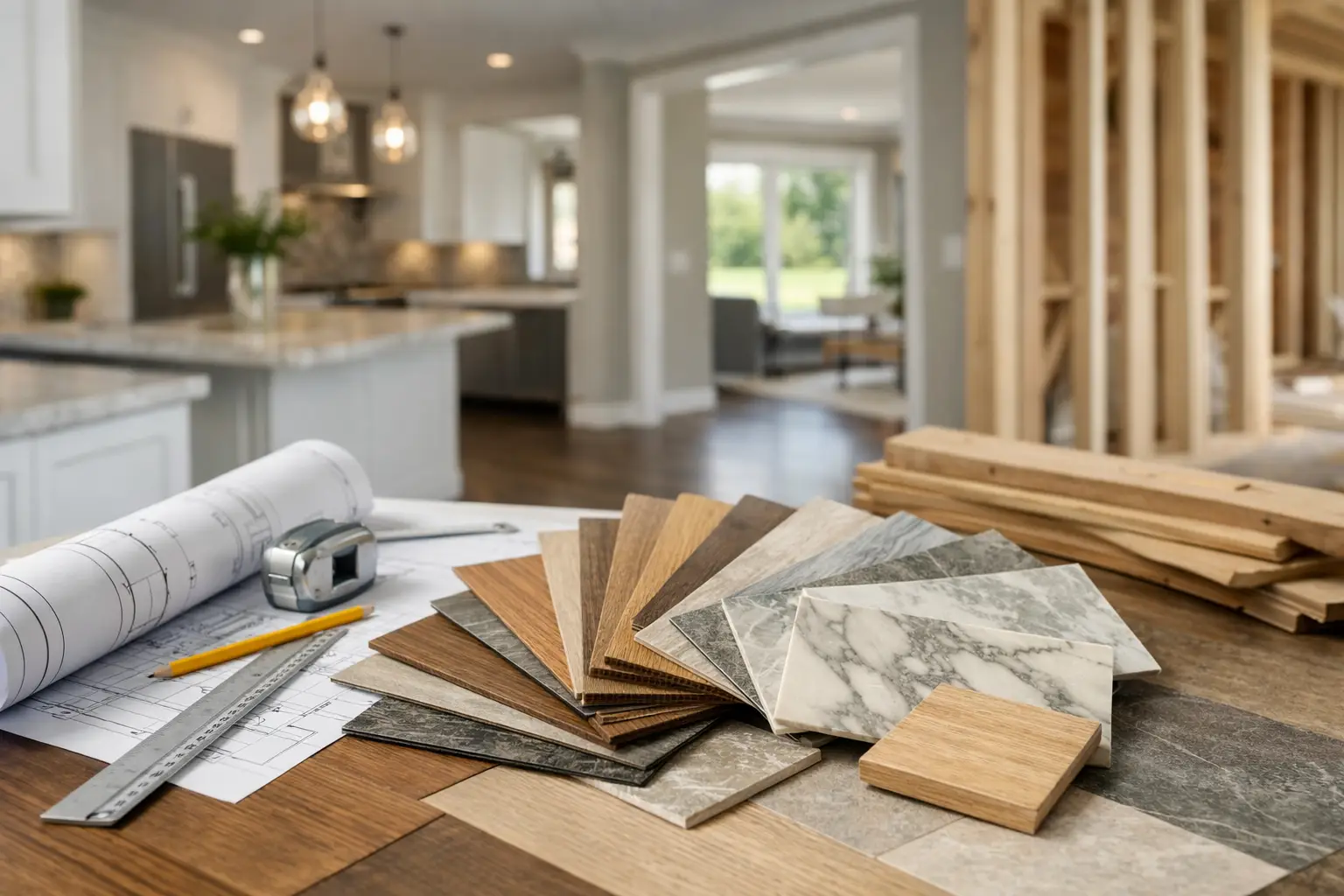
The wrong floor usually looks fine on day one. Problems show up six months later – cupping near a back door, cracked grout over a flexing subfloor, or scratch patterns in a family room that gets used the way family rooms actually get used. That is why how to choose flooring materials is less about samples in a showroom and more about matching material performance to the house, the room, and the way you live.
In New Jersey, that match matters even more. A finished basement in Livingston has different moisture risk than a second-floor primary suite in Summit. A 1920s Maplewood colonial may have subfloor irregularities and seasonal movement that affect tile tolerances. A large-format porcelain install in Short Hills has layout and flatness requirements that do not apply to a standard LVP bedroom job. Flooring is not one decision. It is a series of technical decisions that need to work together.
How to choose flooring materials starts with the room
Most flooring mistakes happen because people shop by appearance first and room conditions second. That order should be reversed.
Kitchens, mudrooms, powder rooms, and basements take moisture exposure more seriously than living rooms or bedrooms. In those areas, water resistance and dimensional stability matter more than a perfect grain pattern. That is why tile and porcelain often make sense in wet zones, while certain LVP products can work well in lower-level spaces where humidity swings are real.
Bedrooms and formal living spaces are different. Here, underfoot feel, sound, and visual warmth carry more weight. Hardwood still wins on long-term character in many of these rooms, especially in premium NJ homes where owners want continuity with existing millwork, stair parts, and trim profiles. But hardwood is not automatically the right answer everywhere. If you have large dogs, active kids, or direct access to a patio, the wear profile changes fast.
Bathrooms need another level of honesty. Wood flooring in a bathroom can look excellent, but it is less forgiving around repeated water exposure, especially near tubs, showers, and toilet flanges. Tile remains the safer technical choice in most primary and hall bath applications.
Understand the four materials most homeowners actually compare
In real projects, most people are deciding between hardwood, engineered wood, luxury vinyl plank, and tile or porcelain. Each has a valid use case. Each also has failure points.
Hardwood
Solid hardwood gives you the longest visual lifespan if the house conditions support it. It can be refinished multiple times, it ages well, and in towns like Chatham, Madison, and Bernardsville, it usually aligns with the architectural expectations of the home. If the goal is long-term value and traditional finish quality, hardwood is still the benchmark.
The trade-off is movement. Wood expands and contracts with humidity. That matters in NJ, where winter heat dries interiors and summer humidity pushes moisture levels back up. Hardwood also does not love wet mops, pet bowls, or basement slabs. It performs best on stable above-grade levels with proper acclimation and consistent interior climate control.
Engineered wood
Engineered wood makes sense when you want the look of real wood but need more dimensional stability. Because of its layered construction, it generally handles humidity fluctuation better than solid hardwood. That can be useful in renovations where the existing house envelope is less predictable or where a wider plank is part of the design intent.
Not all engineered products are equal. Veneer thickness matters. Core composition matters. So does the finish system. Some lower-tier products look good in a sample but have limited refinish potential and weaker wear layers. If you are comparing engineered wood options, do not stop at color and width.
Luxury vinyl plank
LVP has a valid role in the market, especially for basements, certain investor renovations, and households that want easier maintenance. It handles moisture better than wood-based products and can offer a fast visual upgrade when the right product is paired with a properly prepared substrate.
The catch is that LVP is only as good as the floor beneath it. If the slab or subfloor is out of tolerance, you will feel it. Deflection, telegraphing, edge stress, and premature wear usually trace back to prep, not the click mechanism itself. LVP is also not a perfect fit for every premium home. In a high-end custom build or major addition, it may be the right performance choice in one zone and the wrong aesthetic choice in another.
Tile and porcelain
Tile and porcelain are the workhorses for wet areas and some high-traffic zones. They are durable, easy to maintain, and ideal where water is part of normal use. Large-format porcelain is especially popular in upscale NJ remodels because it delivers a clean, modern finish with fewer grout joints.
But tile is unforgiving. The substrate must be stiff enough. The floor must be flat enough. Layout matters. Lippage control matters. In older Essex County homes, where framing may have settled over decades, those conditions need to be checked before material selection is finalized. A beautiful tile chosen without regard to floor structure is just a delayed repair.
The subfloor decides more than the sample board
A lot of homeowners ask which flooring material is best. The better question is which material is best for this subfloor.
On a wood-framed floor, you need to think about deflection, fastening, transitions, and height buildup. On a concrete slab, you need to think about moisture vapor, patching, flatness, and whether a below-grade installation changes the material choice. In a pre-1978 home, floor demolition can also intersect with lead-safe work practices depending on adjacent painted components and scope.
This is where engineering discipline matters. A 3/16-inch variation over a short run may not sound like much, but with rigid tile or long LVP planks, it can become a visible problem. Flooring is finish work. Finish work exposes what rough work hides.
How to choose flooring materials by lifestyle, not just design
If the house has two kids, one large dog, and a kitchen that opens directly to a backyard, choose with that reality in mind. If this is a formal second residence with low daily wear, that is a different decision tree.
Ask practical questions. Do you want a floor that can be refinished, or one that is easy to replace in sections? Are you sensitive to footfall noise on the second floor? Do you need slip resistance in a mudroom where winter salt and meltwater are routine? Are you trying to match existing flooring in a 4,000-square-foot home, or are you comfortable with intentional transitions between spaces?
In higher-end homes, continuity is often worth protecting. Mixing too many flooring types can make a house feel chopped up. But forcing one material across every room usually creates technical compromises somewhere. Good selection balances visual consistency with room-specific performance.
Budget matters, but replacement cycle matters more
The cheapest square-foot option is not automatically the lower-cost decision over time. Neither is the most expensive material automatically the smartest investment.
A floor that lasts 20 years with one refinish cycle can outperform a floor that needs partial replacement much sooner. But that depends on use, maintenance, and installation quality. Material cost, prep scope, trim adjustments, underlayment, floor leveling, demolition, and transition details all affect the real job cost. That is why line-item clarity matters more than headline pricing.
For investors, this calculation is different from owner-occupied custom homes. In a flip, the right flooring decision is often based on speed, durability, and alignment with resale expectations in that specific submarket. In a long-term primary residence, comfort and longevity usually deserve more weight.
A practical way to narrow the decision
If you are stuck between options, narrow it in this order: moisture exposure, subfloor condition, wear level, design intent, then maintenance tolerance. That sequence usually eliminates the wrong options quickly.
For example, a finished basement in West Orange with known seasonal humidity likely moves tile, LVP, and certain engineered products to the front of the conversation while pushing solid hardwood back. A second-floor hallway in a Millburn colonial may lean hardwood or engineered wood to preserve continuity with adjacent rooms and stairs. A primary bath in Franklin Lakes usually belongs in porcelain or tile unless there is a very specific design reason to accept the added risk of wood.
That is also the point where installation method should be discussed, not assumed. Nail-down, glue-down, floating, uncoupling membrane, crack isolation, self-leveling, and moisture mitigation are not backend details. They are part of choosing the floor.
The best flooring choice is usually not the one that wins every category. It is the one that fits the room, the structure, and the way the house is actually used. If you evaluate flooring that way, you make fewer emotional decisions at the sample rack and far fewer expensive corrections after move-in.