
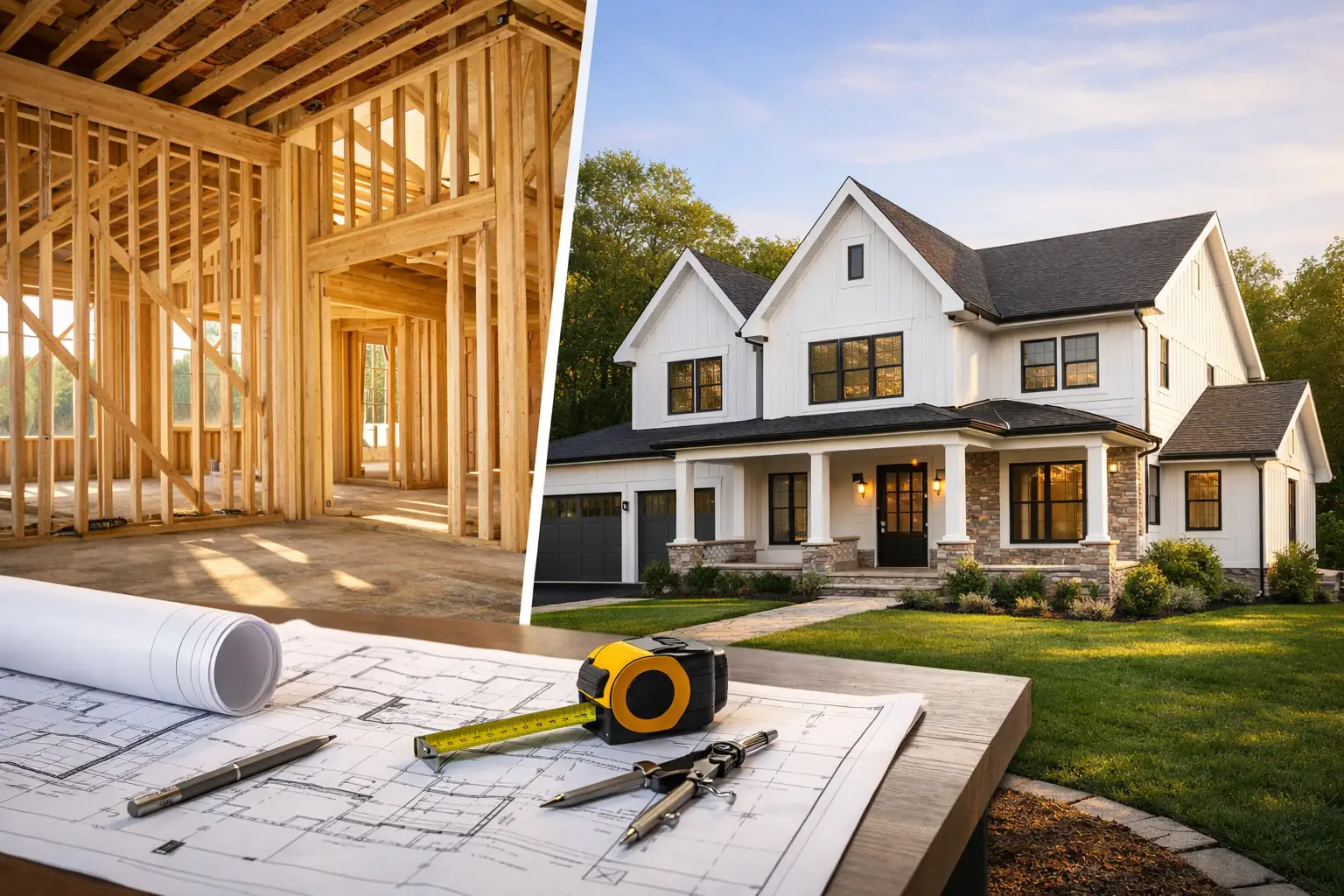
If you are comparing builders in New Jersey and keep seeing the term what is a semi custom home builder, the short answer is this: it is a builder who starts with a proven home plan and gives you controlled flexibility instead of a blank sheet of paper.
That distinction matters more than most homeowners expect. In towns like Chatham, Summit, Short Hills, and Franklin Lakes, the difference between custom and semi-custom affects not just design freedom, but permit strategy, structural revisions, engineering time, and how many decisions you will need to make before framing starts.
What is a semi custom home builder, exactly?
A semi-custom home builder typically offers a library of base plans, elevations, and finish packages that can be modified within a defined range. You are not designing every wall, roofline, and structural span from zero. You are selecting a starting point that already works, then adjusting it to better fit your lot, your family, and your priorities.
In practical terms, that usually means you can change items like kitchen layout, bathroom configuration, flooring, cabinetry, exterior materials, ceiling details, lighting, and in some cases room sizes or first-floor flow. But those changes happen inside a framework the builder already knows how to price, schedule, engineer, and build.
That is why semi-custom sits between two other categories. It offers more personalization than a production builder putting up the same house repeatedly, but less design freedom than a true custom home builder developing plans around your property from the ground up.
Where semi-custom fits between production and custom
A lot of confusion comes from builders using the same words differently. One company may call itself custom when it is really semi-custom. Another may advertise semi-custom but allow enough structural change that the job functions more like a full custom build.
The cleanest way to think about it is by starting point.
A production builder starts with fixed plans and limited options. A semi-custom builder starts with repeatable plans but allows meaningful modifications. A custom builder starts with your lot, your zoning constraints, your program, and your design goals.
That starting point changes the whole process. On a true custom home in New Jersey, the team may need to study lot coverage, setback restrictions, drainage conditions, grading, tree removal, utility runs, and architectural fit before the design is even settled. In a semi-custom process, some of that work still happens, but the house concept is already mostly established.
For homeowners who want a more efficient path without giving up the ability to personalize the home, that can be a smart middle ground.
What can you usually change in a semi-custom home?
This depends on the builder, and this is where buyers need to ask direct questions.
With most semi-custom builders, finish selections are the easiest changes. Flooring species, tile formats, cabinet colors, countertop materials, plumbing fixtures, trim details, paint colors, and appliance packages are usually flexible. Some builders also allow larger changes such as expanding a family room, adding a first-floor office, reworking a primary bath, or converting a two-car garage layout for storage.
Structural changes are where the limits start to show. Moving a powder room is one thing. Reworking load paths, changing stair geometry, adding wide-span openings, or altering the roof system is another. Once those revisions affect engineering, framing complexity, or township review, the project can drift away from semi-custom efficiency and start behaving like a custom build.
In older NJ neighborhoods, lot conditions can tighten those limits further. A plan that works on a wide lot in Mendham may not fit a narrower infill lot in Maplewood. Basement water table concerns, existing foundation removal, tree ordinances, and utility locations can all force plan changes that are bigger than they sound on paper.
Why homeowners choose semi-custom
The main reason is not just cost. It is decision control.
Full custom homes require hundreds of decisions, many of them early, and many with downstream effects. Window size affects elevation balance and structural headers. Roof complexity affects framing time and drainage. Kitchen layout affects plumbing, HVAC routing, electrical planning, and cabinet lead times. Some homeowners want that level of control. Others do not.
A semi-custom builder narrows the field. Instead of solving every problem from zero, the builder is working from a plan that has already been tested in the field. That usually leads to more predictable estimating, fewer design dead ends, and a cleaner preconstruction path.
For busy professional households, that matters. If both owners work full time and have already lived through one renovation, they often want solid choices, not endless choices.
The trade-offs most builders gloss over
Semi-custom is not automatically better or worse. It is better for certain priorities.
The biggest advantage is efficiency. A builder can schedule and price more accurately when the design basis is familiar. The risk of over-designing beyond the lot or budget is lower. Material selections can move faster because the builder already has a system.
The trade-off is that the home may not be fully optimized around your property. If your lot has unusual topography, a difficult rear-yard slope, or zoning pressure on height and coverage, a semi-custom plan may need enough adaptation that its original efficiency starts to disappear.
There is also the issue of compromise. You may get 85 to 90 percent of what you want, but not every exact room proportion, circulation pattern, or facade move. For some families, that is perfectly rational. For others, especially those building a long-term home in places like Alpine or Saddle River, those compromises can become frustrating once construction begins.
This is why engineering review matters. A builder should be able to explain not just whether a change is possible, but what it does to structure, permitting, sequencing, and inspection risk.
How to tell if a builder is truly semi-custom
Ask how the process starts. If the builder begins with a portfolio of floor plans and standard specification levels, that is usually semi-custom territory.
Then ask what percentage of the home can realistically change without rewriting the entire project. Not the marketing answer. The construction answer. Can you move walls? Can you resize rooms? Can you alter the foundation footprint? Can you change window groupings? Can the HVAC and framing systems absorb those changes without major redesign?
Also ask who owns preconstruction coordination. In New Jersey, the gap between design and build is where many projects lose time. Township permit comments, structural plan revisions, survey updates, and site constraints all need active management. A builder with engineering-led discipline should be able to map out that process in plain language.
That matters in real local conditions. A semi-custom home on a clean suburban lot in Basking Ridge is one scenario. A teardown or major rebuild in an older Essex County neighborhood with tight setbacks, drainage concerns, and inspector-specific documentation expectations is another.
Is semi-custom right for your project?
Usually, yes, if you want personalization but do not need complete architectural freedom.
It is a strong fit for homeowners who like an existing plan, want to make it more theirs, and care about reducing avoidable design time. It also works well when the lot is straightforward and the family program is clear. Four bedrooms, home office, open kitchen-family space, finished basement, and practical upgrades to materials and lighting – that is a profile that often fits well inside a semi-custom model.
It may be the wrong fit if the lot is unusually constrained, if the home needs to respond to a very specific lifestyle, or if you already know you want something highly tailored. In those cases, trying to force a semi-custom plan into a custom problem can create more revisions than starting custom in the first place.
For that reason, the best conversations happen early and honestly. Not what sounds cheaper. Not what sounds more premium. What actually fits the site, the scope, and the way you want to live in the house.
At Gus Skyy Construction, we see this decision most clearly when homeowners stop asking what category sounds better and start asking the more useful question: how much flexibility do we really need, and where does that flexibility add value?
That is the right lens. A semi-custom home builder is not selling less house. The right one is offering a structured path to a home that feels personal without turning every design choice into a new construction variable. If that balance matches your project, it is often the smartest way to build.