
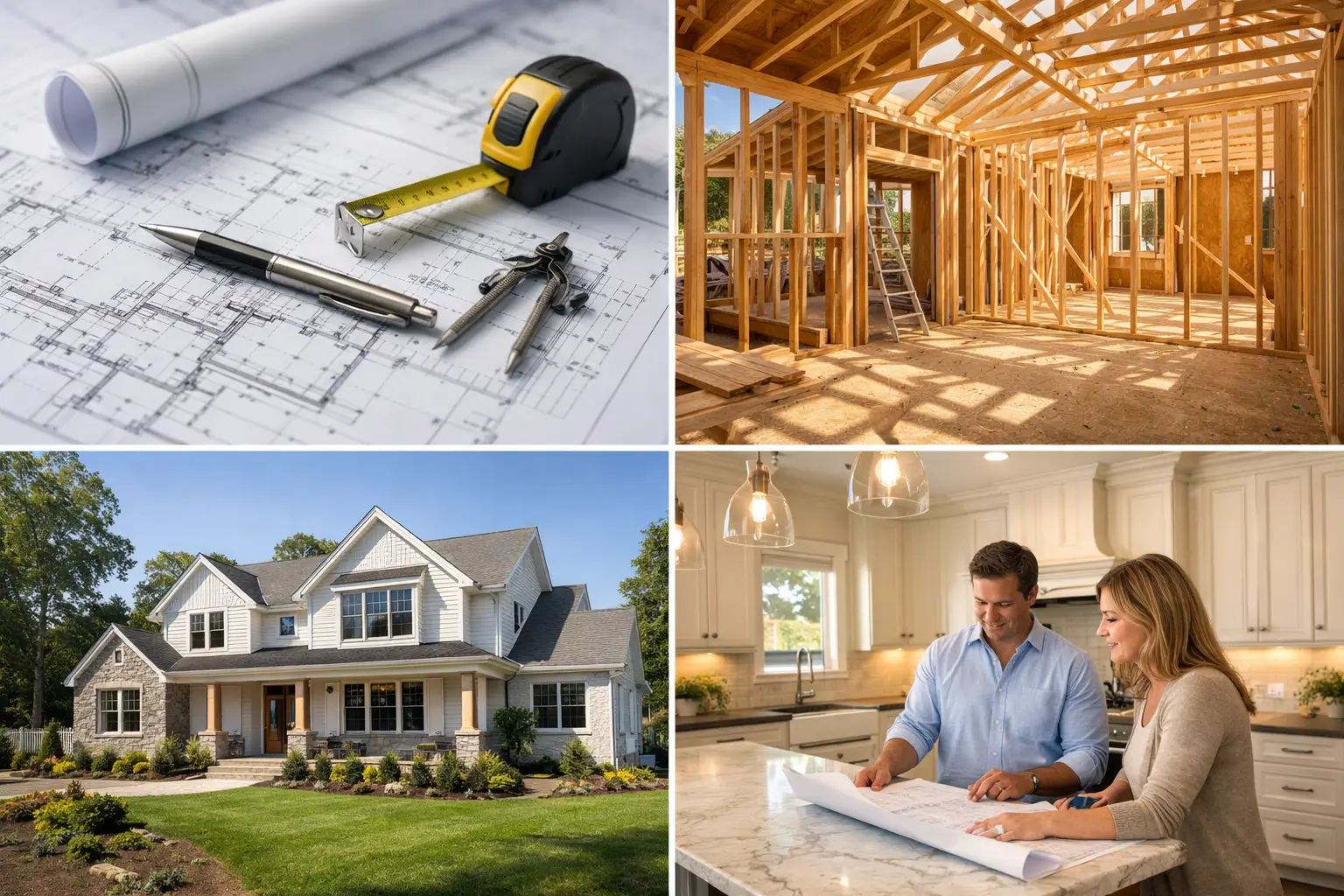
A custom home usually goes off track before excavation starts. Not because the framing crew missed something, but because the early decisions were made in the wrong order. If you want to understand the real steps to building a custom house, start with this: the lot, the budget, the design, and the permitting strategy have to work together from day one.
In New Jersey, that coordination matters more than many homeowners expect. A house planned for Short Hills will face different grading, zoning, and inspection issues than one in Franklin Lakes or Bernardsville. Soil conditions, stormwater requirements, septic versus sewer, tree removal rules, and township review speed all affect the path forward. The cleanest builds are usually the ones that treat preconstruction like an engineering exercise, not a mood board.
Step 1: Start with the lot, not the floor plan
Many owners fall in love with a layout before they know what the property can actually support. That is backwards. The lot dictates setbacks, building coverage, height limits, drainage strategy, driveway placement, and sometimes even the best location for the garage or basement walkout.
On a North Jersey site, topography alone can change the entire build approach. A sloped lot in Alpine or Saddle River may require significant retaining and stormwater work. A flatter infill lot in Maplewood or Westfield can still create problems if drainage pushes toward neighboring properties. Before design gets too far, you need a survey, zoning review, and a realistic read on what the site allows.
If the property has an older home on it, demolition is not just a demolition question. Utility disconnects, tree protection, lead-safe procedures for pre-1978 conditions, and disposal logistics all need to be addressed early.
Step 2: Build the budget around scope, not guesses
A custom home budget should not be one large number with a vague allowance for “finishes.” It should be tied to square footage, structural complexity, mechanical systems, finish level, and site conditions. A simple two-story rectangle and a home with long steel spans, large window walls, and deep rear excavation are not in the same category, even if the total square footage looks similar on paper.
This is where homeowners either gain control or lose it. A line-item budget does more than show cost. It forces decisions. Do you want wider plank white oak throughout the first and second floor, or a larger glazing package in the rear? Do you want radiant heat in the primary bath, or do those funds belong in exterior masonry, site walls, or a more capable HVAC setup?
For serious planning, the budget should account for hard construction scope, permit-related costs, design and engineering, utility work, and contingencies for conditions that may not be fully visible at the beginning. In older NJ neighborhoods, hidden field conditions are common. Existing foundations can be inconsistent. Water service locations may not match old records. Soil and groundwater can surprise you.
Step 3: Assemble the right design and build team early
The best custom builds do not hand off the project from one silo to another. They coordinate architecture, structural thinking, buildability, and permitting from the front end. That does not mean rushing design. It means designing with construction reality in mind.
A home can look clean on paper and still be expensive or inefficient to build because of unnecessary structural gymnastics, overcomplicated rooflines, or details that create inspection delays. This is especially common in high-expectation markets like Summit, Chatham, and Tenafly, where owners want a refined product but also expect schedule discipline.
An engineering-led design-build approach helps here because the team is reviewing spans, bearing points, drainage, and sequencing while the plans are still flexible. That usually leads to better decisions before money is spent in the field.
Step 4: Design for the township you are actually building in
This is one of the most overlooked steps to building a custom house. Homeowners tend to focus on the house and underestimate the municipality. In New Jersey, township process matters. A lot.
Some towns are relatively straightforward if your plans conform to zoning. Others can be slower, more layered, or more particular about grading, drainage, tree removal, or historic review. Bergen County and Essex County projects can feel very different even when the houses are similar in size. Some inspectors want cleaner sequencing of rough inspections. Some zoning offices scrutinize lot coverage calculations closely. Some towns move quickly on resubmissions, and some do not.
This is why permit strategy should be discussed during design, not after. If the project may trigger variance relief, expanded drainage submissions, or utility coordination issues, that affects schedule and carrying costs. It is better to know that before CDs are finished.
Step 5: Complete engineering before construction starts
Permit-ready drawings are not the same as field-ready coordination. Before mobilization, the structural set, architectural set, and site information should agree with each other. Floor elevations, stair geometry, framing loads, beam depths, window sizing, and HVAC chases need to be reconciled.
In custom homes, small misses at this stage create expensive field decisions later. A dropped beam where a flush ceiling was expected. A plumbing run that conflicts with a structural member. A rear slider that needs more header depth than the current section allows. These are solvable problems, but solving them after framing starts is slower and more expensive.
Preconstruction should also cover logistics. Material lead times matter. If the project depends on custom windows, specialty tile, XL porcelain slabs, or certain flooring formats, procurement needs to line up with the build sequence.
Step 6: Treat sitework and foundation as critical path work
Homeowners tend to think of excavation and foundation as basic phases. They are not. These stages determine whether the rest of the project moves cleanly.
Sitework includes clearing, grading, utility trenching, temporary access, erosion controls, and drainage planning. In many NJ builds, especially where basements are involved, water management is one of the most important technical decisions on the job. A basement is only as good as the waterproofing, drainage board, footing drains, discharge strategy, and grading around it.
If the lot has poor drainage or a high water table, that needs to be handled with facts, not optimism. This is where engineering discipline matters. It is much easier to solve moisture risk before the slab is poured than after the basement is finished.
Step 7: Frame the house with the mechanicals in mind
Framing gets attention because it is visual. The house starts to feel real. But framing quality is not just about straight walls and roof lines. It is about setting up the next trades correctly.
Good framing anticipates duct paths, plumbing stacks, recessed lighting, steel bearing requirements, and finish tolerances. If the framing team builds without considering the HVAC layout or bath stack locations, later trades are forced to cut, notch, fur, and patch their way through the structure. That is not efficient, and it often shows up in the final product.
This phase is also where window and door openings, staircase alignment, and floor flatness need attention. Finish quality later depends heavily on what happened here.
Step 8: Do not under-plan the interior systems and finishes
Custom homeowners usually spend a lot of design energy on kitchens and primary baths. Fair enough. But the projects that run better are the ones that also make early decisions on insulation strategy, HVAC zoning, electrical load planning, lighting control, flooring transitions, tile layout, and millwork dimensions.
For example, if you are using wide-format tile in a bath and long-plank hardwood across adjoining spaces, the subfloor prep and finished floor heights need to be coordinated early. If the home includes a large kitchen with heavy appliance load, exterior lighting, EV charging, and multiple HVAC systems, your electrical planning cannot be an afterthought.
This is also where realism helps. Not every upgrade returns equal value. Some are worth it because they improve daily use. Others look good in a showroom but complicate installation, maintenance, or replacement down the road.
Step 9: Manage the build through inspections, not around them
A custom house is not complete when the work looks finished. It is complete when the work is installed correctly, inspected in sequence, and documented properly.
NJ projects move through footing, foundation, framing, plumbing, electrical, insulation, and final inspections, with variations by town and scope. The key is not just passing inspections. It is avoiding avoidable failures and reschedules. Missed paperwork, incomplete rough-ins, or poor sequencing can waste weeks.
A disciplined builder tracks dependencies closely. If one item slips, the schedule should adjust with intention, not confusion. That matters on any project, but especially in active family homes, knockdown-rebuilds, and high-value towns where owners are coordinating school-year moves, leases, and financing milestones.
Step 10: Finish with punch control and turnover discipline
The last stage is where many projects feel 95 percent done and then stall. Usually that happens because punch work was not tracked properly or because materials and installer sequencing were not locked down.
Final turnover should include more than cosmetic touch-ups. It should cover fixture operation, equipment startup, warranty documentation, final permits, and a clean walk-through process. A homeowner should know how the systems work, where shutoffs are located, what maintenance the materials require, and which items need monitoring through the first seasonal cycle.
That handoff matters in New Jersey. Homes here deal with freeze-thaw movement, humidity swings, basement moisture pressure, and strong seasonal HVAC demand. A house is not just handed over. It is commissioned for real use.
If you are planning a custom build, the smartest move is to slow down the first 10 percent of the job so the next 90 percent does not turn into correction work. The right home is not the one with the most features on paper. It is the one whose design, engineering, permits, sequencing, and finish decisions all make sense together.